
Last updated August 25, 2026
Free on-site gate assessment - hinges, posts, and your LiftMaster or Nice gate operator checked before anything is quoted
The assessment is free and the quote is the invoice.
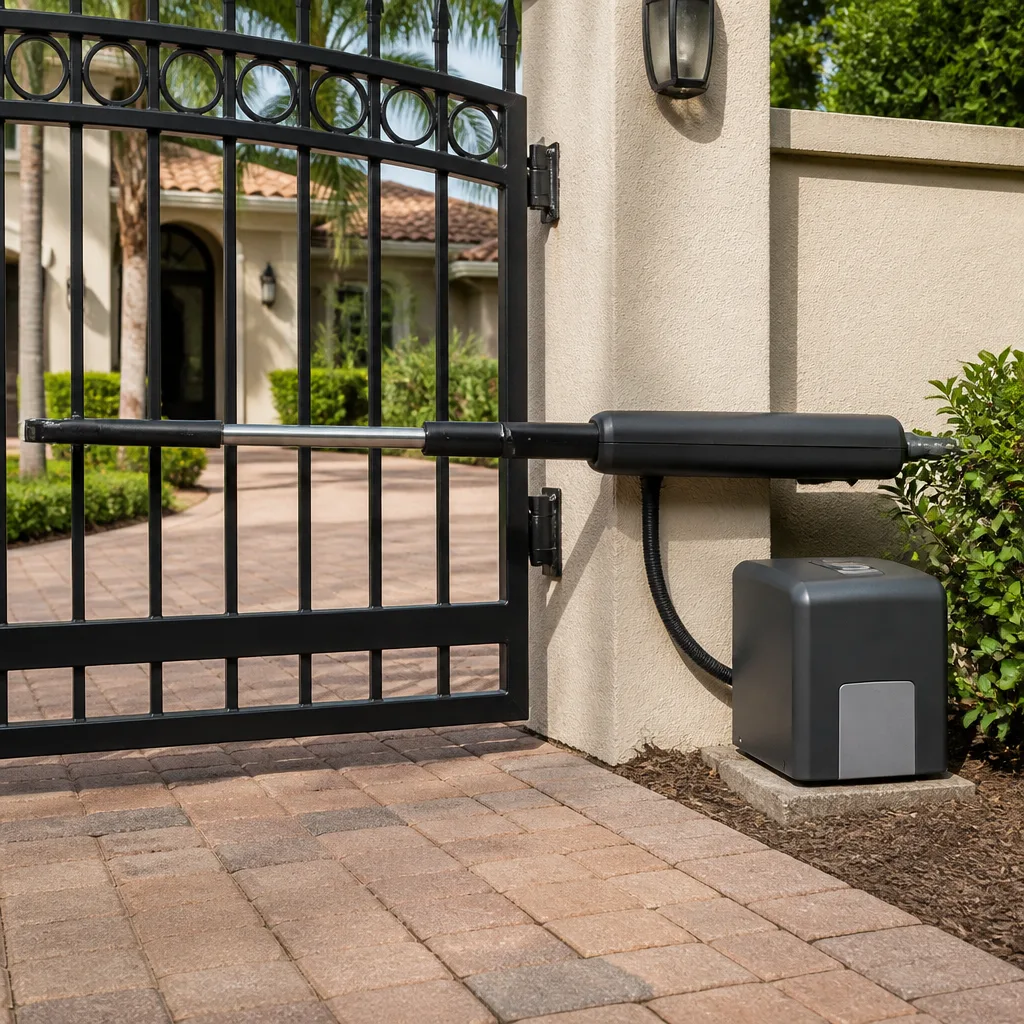
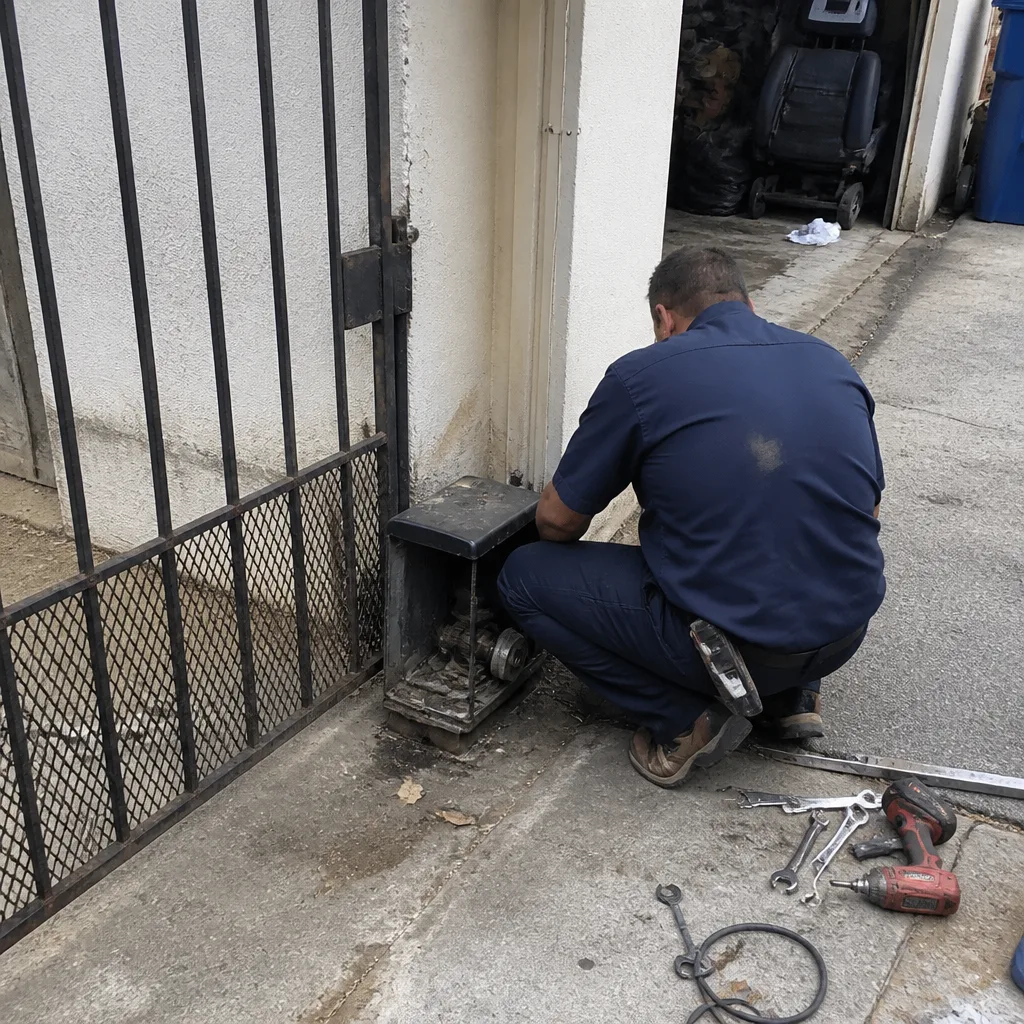 Before
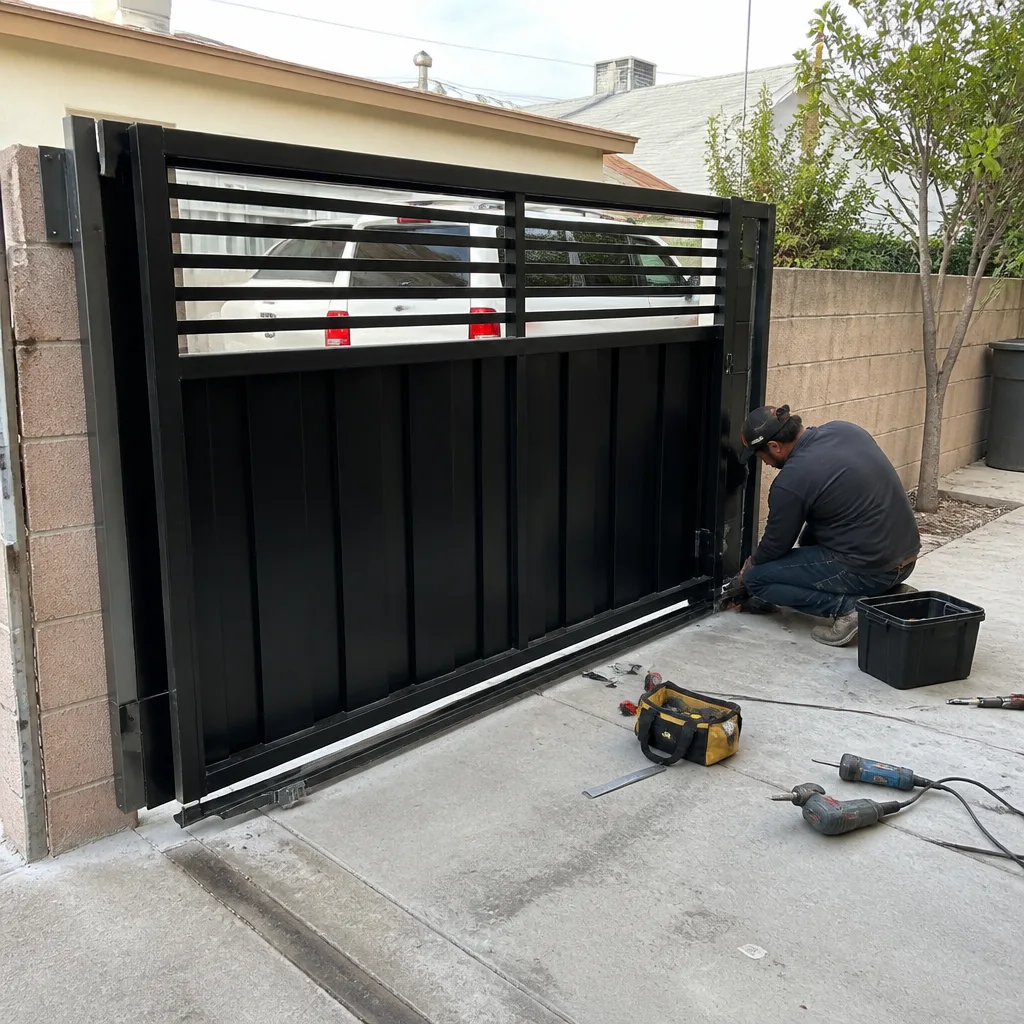 After
After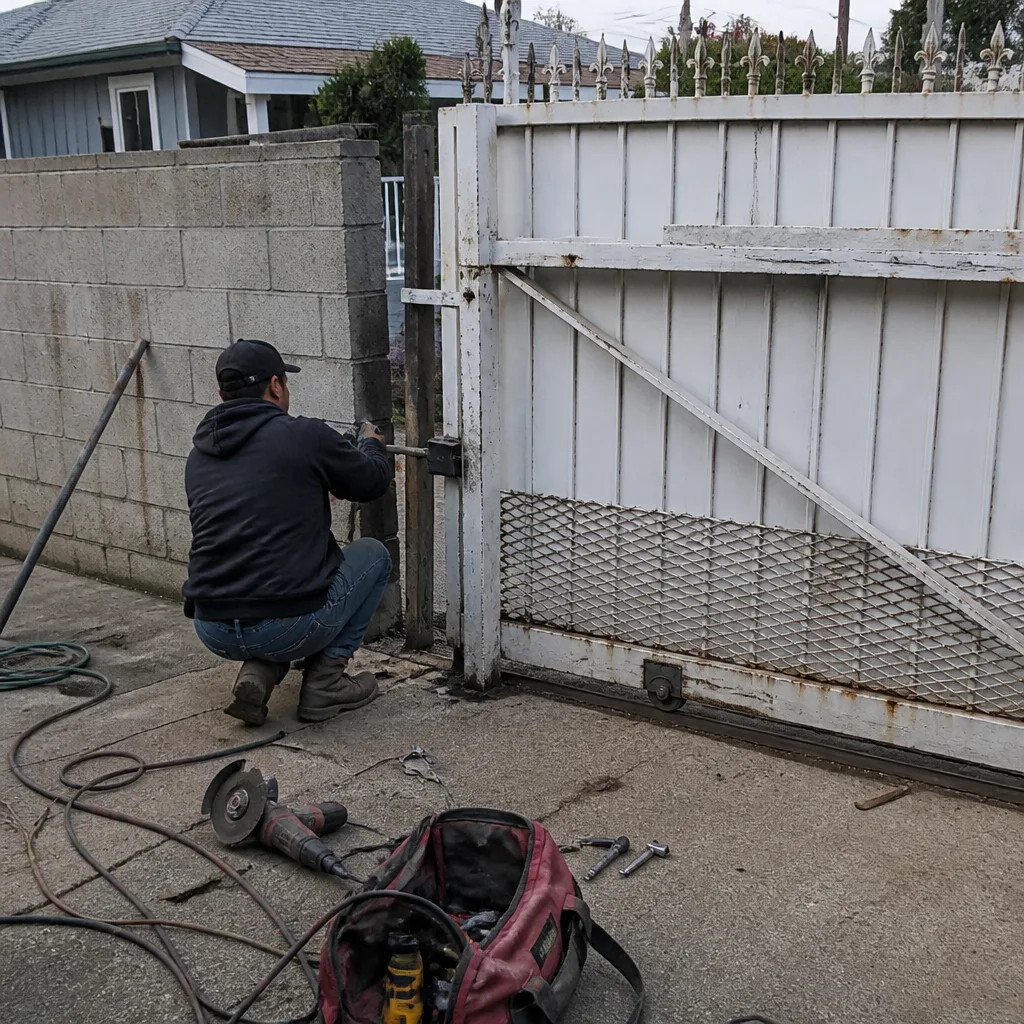 Before
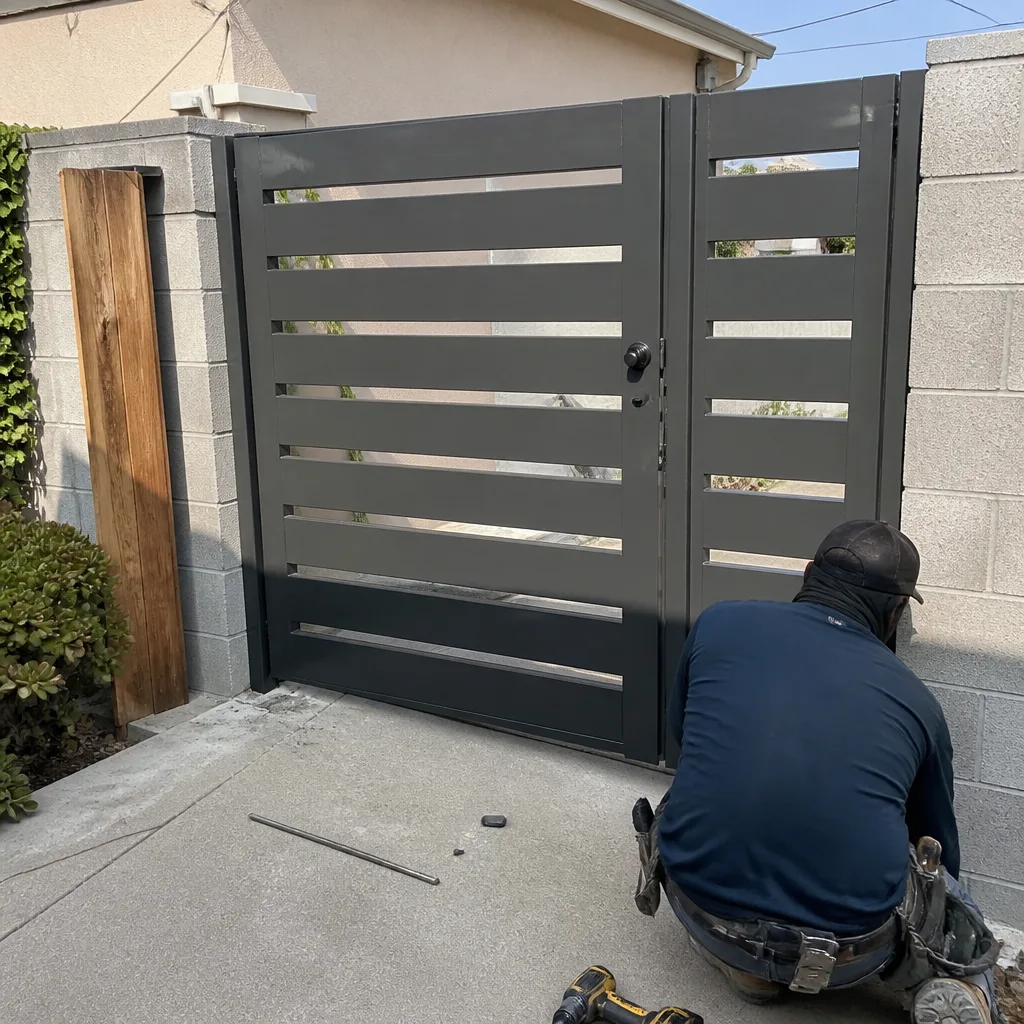 After
After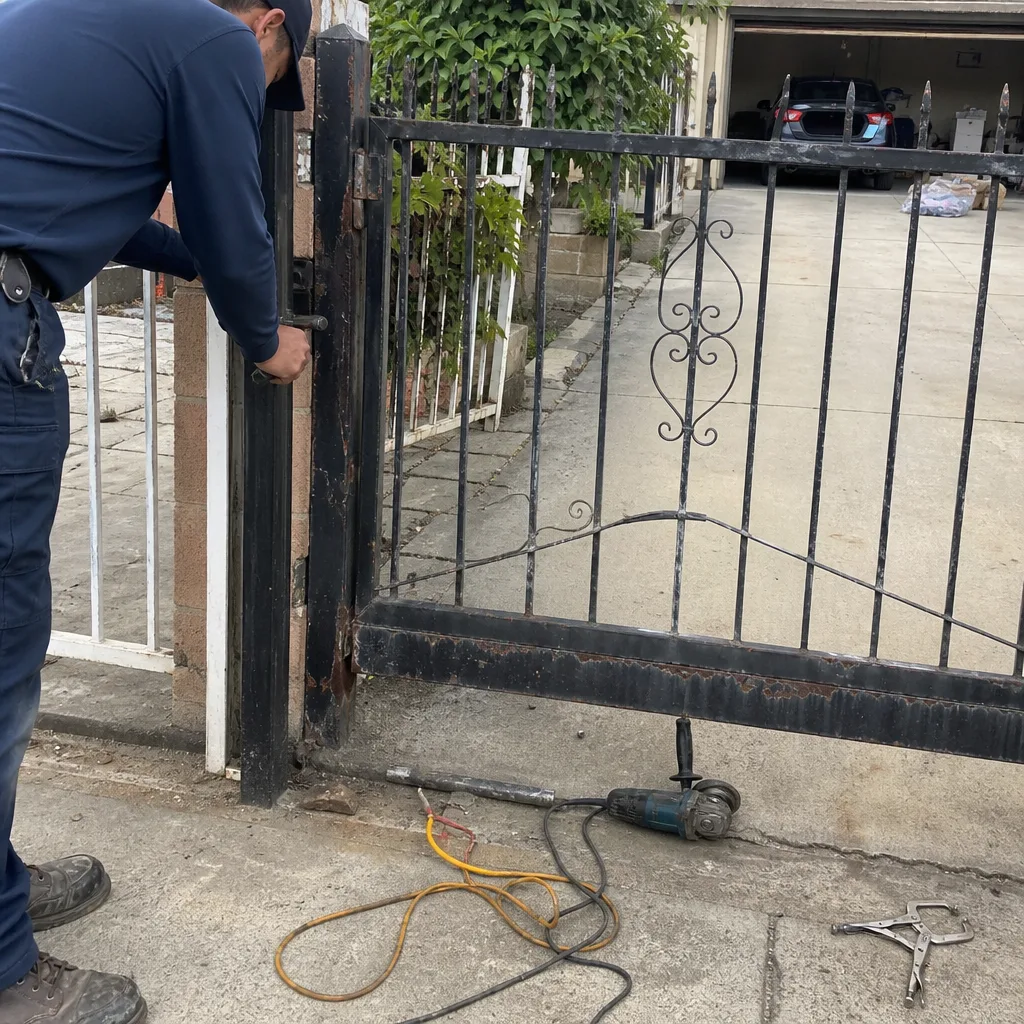 Before
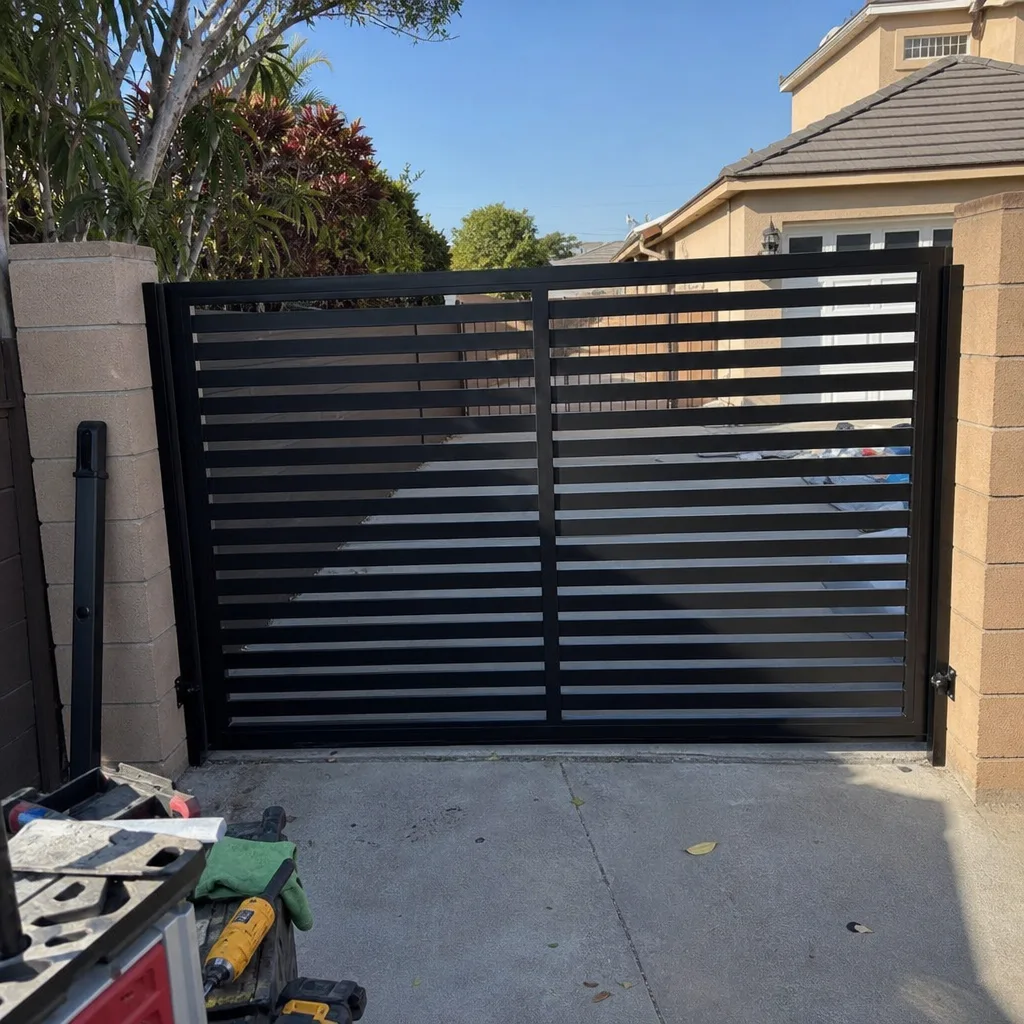 After
AfterGate Repair Warning Signs: A Huntington Park Homeowner’s Reference Guide
Most gate failures in Huntington Park don’t happen suddenly. They announce themselves weeks or months in advance, through small changes a homeowner notices but sets aside: a pause halfway across the track, a grind that wasn’t there last month, a sag you can only see when the gate is open. The trouble is that by the time one of these warnings becomes impossible to ignore, the repair has usually moved from a $150 hinge replacement to a $1,400 motor rebuild. This guide walks you through the warning signs we’ve learned to recognize over four decades in this trade, what each one means, what it costs to fix in Huntington Park, and which ones demand a phone call before the gate stops moving altogether.
Quick Answer
The most common gate repair warning signs in Huntington Park are: a gate that moves slower than it did last year, a grinding or screeching sound during travel, visible sagging at the hinge side or latch side, a motor that hums but doesn’t move the gate, and a gate that reverses or stops mid-cycle for no apparent reason. Any one of these is worth a professional inspection. Most are $150 to $450 fixes when caught early, and $800 to $2,200 when ignored.
Table of Contents
- A Gate That Moves Slower Than It Used To
- New Noises: Grinding, Screeching, Clicking
- Visible Sagging or a Gate That Drags on the Ground
- The Motor Hums But Nothing Moves
- A Gate That Reverses, Stops, or Opens Partway
- Rust, Weld Cracks, and Fatigue at the Stress Points
- Keypad, Remote, or Intermittent Electrical Failures
- Common Mistakes to Avoid
- When to Call a Professional
- Frequently Asked Questions
A Gate That Moves Slower Than It Used To
This is the warning sign we hear about most often in Huntington Park, and it’s the one homeowners most often talk themselves out of. A sliding gate that took 14 seconds to open last spring and takes 20 seconds now is not “just getting old.” It’s telling you something specific. The motor is working harder than it was designed to work, because something is resisting it. That resistance almost always comes from one of three places: dry or failing bearings in the wheel trucks, a track that has shifted out of alignment, or a motor capacitor that’s losing its ability to hold a charge.
Here’s what each of those means in practical terms:
- Dry or failing wheel bearings: The gate’s weight rides on steel wheels, and those wheels have bearings. When the grease inside breaks down, the wheels don’t roll freely anymore. The motor compensates by drawing more current. This is the most common cause we see on older sliding gates in Huntington Park, especially on properties where the gate track sits close to the street and collects dust.
- Track out of alignment: Soil in Huntington Park shifts with the seasons. Over years, the concrete pad or steel track a gate rides on can settle just enough to create a bind. The gate still moves, but it’s pushing uphill for part of its travel.
- Failing capacitor: On swing-gate and slide-gate openers, the capacitor provides the starting torque. A weak capacitor means the motor starts sluggishly and every cycle takes longer. It’s a $40 part, but the labor to diagnose and replace it correctly is where the value is.
What does it cost to fix? A bearing replacement and track service in Huntington Park typically runs $180 to $320 depending on how many wheels the gate has. A capacitor replacement is usually $120 to $220. The point is this: none of these is a big job when caught early. But if the motor has been laboring against a bad bearing for a year, the motor itself may have already sustained damage. That’s when a $200 fix becomes an $800 opener replacement.
New Noises: Grinding, Screeching, Clicking
Your gate should not make noise. A properly lubricated, properly aligned gate on a functioning opener is nearly silent, especially a chain-drive slide gate. When homeowners in Huntington Park call us about a noise they’ve started hearing, we ask them to describe it as precisely as they can, because the sound itself tells us where to look before we ever arrive.
Here is what the most common sounds typically mean:
- Screeching or squealing during travel: Metal on metal without lubrication. On a swing gate, this usually means the hinge pins have gone dry and are wearing. On a slide gate, it’s usually the wheel trucks or the chain. If caught early, the fix is cleaning and lubrication, maybe a bushing replacement: $100 to $200. If ignored, a dry hinge pin wears the hinge barrel out of round, and the entire hinge must be welded off and re-welded: $350 to $700.
- Grinding at the motor: This is more serious. It usually indicates a failing gear inside the opener’s gearbox, or a chain that has come out of adjustment and is chewing against the sprocket. A grinding opener is a few weeks from a dead opener. We service nine opener brands including LiftMaster and FAAC, and this failure mode is common across all of them when the gearbox oil hasn’t been checked in years.
- Clicking at startup: A rapid click when the opener tries to start often points to a failing capacitor or a tripping limit switch. Sometimes it’s electrical, sometimes it’s mechanical. Either way, it’s a cheap diagnosis and usually a quick fix.
One note specific to Huntington Park: gates here sit in an environment where the air carries fine particulate from the nearby industrial corridors and constant traffic along Pacific Boulevard and Santa Fe Avenue. That dust works its way into chains, hinges, and gearboxes faster than it would in a coastal neighborhood with cleaner air. We recommend seasonal lubrication in this area even when nothing seems wrong. It costs less than any repair it prevents.
Visible Sagging or a Gate That Drags on the Ground
A sagging gate is the easiest warning sign to see and the most consistently ignored one. The gate leans away from the hinge post, the latch no longer lines up with the catch, and eventually the leading edge scrapes the driveway. In Huntington Park, where many homes have ornamental steel gates that are 20 to 40 years old, sagging is extremely common on the original equipment.
The mechanism is simple. A swing gate is a big lever. The entire weight of the gate hangs off the hinge side. Over decades, the hinge post itself can lean, the hinges can bend, or the welds can develop micro-cracks that open and close with every cycle. On a slide gate, the equivalent failure is a wheel truck that has flattened on one side or a track that has settled at one end.
What makes sagging dangerous is that it loads components they were never designed to carry. A sagging gate pushes down on the opener arm, which bends the arm, which breaks the internal gears of the opener. It stresses the latch, which jams, which tempts someone to force the gate open by hand. Forced gates bend frames. Bent frames are expensive.
Here’s how we assess a sagging gate when we see one in Huntington Park:
- Check the hinge post first. If the post itself has moved, the fix is structural: reset and re-concrete the post, usually $600 to $1,200 depending on access and whether fencing is attached.
- Check the hinges. If the post is solid but the hinge leaves are bent or the pins are worn, hinge replacement or weld repair is typically $250 to $500.
- Check the frame. If the gate frame itself has racked, it sometimes needs to be realigned and re-welded, which can run $400 to $900 depending on the extent.
Most sagging gates in Huntington Park are a combination of all three, in varying proportions. That’s why we always quote the job after seeing it in person. A photo gives a rough idea. But a sag you can see in a photo has already been forming for years.
The Motor Hums But Nothing Moves
This is the warning sign that most often generates a same-day phone call, because it’s frightening. You press the remote, you hear the motor strain, but the gate doesn’t budge. A humming motor that won’t move the gate is doing one of a handful of very specific things, and diagnosing it correctly saves real money.
The most common causes, in order of how often we see them in Huntington Park:
- Capacitor failure: If the capacitor can’t produce the initial torque spike, the motor hums but can’t start turning. This is a straightforward replacement, typically $120 to $220, and it’s the best-case scenario.
- Failed gear inside the opener: The motor spins but the output shaft doesn’t. The humming is the motor running against a stripped gear. This is a replacement-level repair inside the opener, usually $350 to $600 to rebuild, and sometimes more than the opener is worth if the opener is old.
- Mechanical bind: The opener is fine, but the gate itself is stuck. A wheel has seized, a track has shifted, a hinge has locked up. The motor hums because it’s trying to move an immovable object. This is the one case where fixing the gate, not the motor, solves the problem. Typically $200 to $500 depending on the bind.
- Dead battery backup: If your opener has a battery backup and the battery has failed, some openers will hum or click but not move. This is more common on newer LiftMaster, Linear, and BFT units. A battery replacement runs $150 to $350 parts and labor.
The critical safety point here: a humming motor is drawing current and generating heat. If the motor is humming for more than a few seconds every time you press the button, stop pressing the button. Every hum cycle pushes a struggling component closer to failure, and in some cases a seized motor can overheat a circuit board. Kill power to the opener at the breaker or the service disconnect if you know where it is, and call a gate professional. This is not a problem that fixes itself, and it is not one you should keep testing.
A Gate That Reverses, Stops, or Opens Partway
Modern automatic gates in Huntington Park are required to have safety devices: photo eyes, safety edges, or both. These devices are there to prevent the gate from closing on a person, a pet, or a car. When a gate stops mid-cycle and reverses, or opens only partway and gives up, the most common culprit is a safety device doing exactly what it was designed to do, or failing in a way that makes the opener think there’s an obstruction.
But there are other causes too, and some of them are more serious:
- Dirty or misaligned photo eyes: The small photo-eye units mounted near the gate’s path get dusty, especially in a climate like Huntington Park’s where wind carries dry particulate. A quick cleaning and realignment often restores normal operation. If the lenses are cracked or the wiring to the eye is compromised, replacement is usually $150 to $300 per pair.
- Bad limit switch: The limit switch tells the opener where “open” and “closed” positions are. A failing limit switch makes the gate stop in the wrong place, or open halfway and stop. Replacement is typically $100 to $250 depending on the opener brand.
- Obstruction in the track: Sometimes the gate is stopping because something is physically in the way. A rock that migrated into the track, a tree root that’s pushed the concrete, a trash can left too close. In Huntington Park, we see a lot of slide gates with tracks that have collected gravel from the driveway itself.
- Low voltage at the opener: If the circuit feeding the opener has degraded, the motor may not get enough power to complete a full cycle. This is more common on long wire runs from the house to the gate, which are typical on larger Huntington Park properties. The fix may be an upgraded wire run, $300 to $800 depending on distance.
Here’s the step-by-step we recommend for a gate that reverses or stops on its own:
- Clear the path. Remove anything within three feet of the gate’s full travel in both directions. Check the track for rocks, leaves, or debris.
- Watch the gate for one full cycle. Stand well clear, and watch where it stops. If it stops at the same place every time, note it. If it stops at random places, that points to electrical issues rather than mechanical ones.
- Check the photo eyes. Look for blinking lights, which often indicate misalignment. Gently wipe the lenses with a dry cloth. Do not adjust the aim unless you know how, because a badly aimed safety eye is a safety liability.
- Call a professional if it happens again. Intermittent faults are the hardest to diagnose without tools, and every false cycle adds wear. We’ll find electrical issues that won’t show up in a one-time visual check.
Rust, Weld Cracks, and Fatigue at the Stress Points
Steel gates in Huntington Park live hard lives. The proximity to the 710 freeway and the industrial areas along Slauson Avenue means the air carries compounds that accelerate oxidation. Most ornamental gates are powder-coated when they’re new, and the coating protects the steel for years. But powder coat chips at the corners, where the gate is struck by the opener arm, and where the latch rides against the frame. Once the coating is breached, rust begins.
Surface rust is cosmetic, and it’s an easy fix: sand the affected area, treat it, and repaint. But rust at the stress points is a structural warning. The stress points on a gate are the hinge weldments, the places where the opener arm attaches, the corners of the frame, and the latch mounting. When rust is visible at these locations, it usually means the coating has been gone long enough for oxygen to begin working into the metal. And once that process starts, it doesn’t stop on its own.
We’ve seen Huntington Park gates where the hinge looked intact from the top but had rusted through on the underside. The gate stayed up because it was held by the paint until the day it wasn’t. A gate that falls is a serious injury risk and a liability. This is not a scare tactic. It’s what fatigue failure looks like in steel: slow, quiet, and then sudden.
What to look for:
- Rust blooms at the hinge welds: Brown staining spreading outward from the weld. This means moisture is under the coating and working into the weld. Have a professional look at it. Weld repair or reinforcement is typically $200 to $500 per affected area.
- Hairline cracks in the paint at corners: Paint doesn’t crack on its own. If you see spiderwebbing or straight-line cracks at a corner, the steel underneath is flexing. Flexing at a corner means the weld has already partially failed.
- A gate that wiggles or shudders when it stops: A properly tensioned gate should stop and hold. Shuddering means there’s play in the frame or the mountings, which means something is loose, cracked, or worn.
Keypad, Remote, or Intermittent Electrical Failures
This category covers the frustrating stuff: the remote works sometimes and not others, the keypad only responds when you press the buttons a certain way, the intercom buzzes but won’t release the gate. In Huntington Park, where many homes built from the 1950s through the 1980s have gate systems that were installed long before the current owner, electrical gremlins are usually the result of age and weather exposure working on low-voltage components.
The causes break down like this:
- Failing remote batteries: The obvious one, but worth saying. A remote whose battery is dying will work intermittently before it stops entirely. Replace the battery first. If the range is still poor after that, the remote’s transmitter may be degraded.
- Water intrusion in the keypad or control box: Huntington Park gets about 14 inches of rain a year, but when it rains, it rains hard. Keypads and control enclosures that are not properly sealed will eventually let water in. Corroded contacts fail intermittently first. That’s the warning. Then they fail permanently.
- Antenna damage on the receiver: The little antenna wire on the control board of the gate opener can break, kink, or corrode. If your remote range has shrunk from across the block to ten feet from the gate, the antenna is a likely culprit.
- Loose wire connections: Gates vibrate with every cycle. Over years, wire nuts and screw terminals inside the control box loosen. A connection that’s loose makes contact sometimes, and other times it doesn’t. That’s the definition of intermittent.
- Photocell wiring degradation: The low-voltage wires that run from the opener to the safety photo eyes are often buried or run along the fence line. When that insulation cracks, moisture gets in and the voltage drops, which trips the safety circuit intermittently.
The frustration here is real, because an intermittent electrical fault is the hardest thing to catch in the act. By the time a technician arrives, the gate might be working perfectly. That’s why we approach these as systematic inspections rather than single-point fixes: check the control board connections, check the wire run, check the antenna, check the keypad seal and contacts, check voltage at the opener. Most of these inspections take under an hour, and most electrical fixes run $150 to $400 once the cause is found.
Common Mistakes to Avoid
- Ignoring the slow gate. A gate that moves slower is a gate that’s already losing the battle against friction. Every week it runs in that condition, the motor runs hotter. That’s how small repairs become opener replacements.
- Greasing everything with WD-40. WD-40 is a water displacer, not a long-term lubricant. It washes out the grease that was already in the hinge or bearing. Use a proper lithium or silicone lubricant on gate components, and only where it belongs.
- Forcing a jammed gate open by hand. When a gate won’t move with the motor, sometimes it can still be moved manually. But forcing it bends the frame, snaps the opener arm, or strips the gearbox. Every forced cycle adds repair cost.
- Replacing the opener without checking the gate. If the gate is binding, a new opener will burn out exactly like the old one did. The gate comes first. The opener moves what the gate allows it to move.
- Waiting until the gate stops completely. Everything in this guide costs less before the failure than after. That’s the whole principle. The gate was warning you. The only question is whether you were listening.
- Buying parts online and guessing. We understand the impulse. But a wrong capacitor, a mismatched hinge, an opener arm that’s not rated for your gate’s weight: each of these wastes money and delays the correct fix. The part is never the expensive part. The misdiagnosis is.
When to Call a Professional
Call when the warning sign first appears, not when the gate stops working. A grinding sound, a slower travel, a sag you can measure, a keypad that only works half the time: these are the early warnings, and they are all cheaper to address now than later. Call if you see rust at the hinge welds or the corners of the frame. Call if the gate has ever reversed when nothing was in the way. Call if the motor hums. Each of these is a conversation, and the conversation is free. Ironworks Gate Co. offers free estimates in Huntington Park. Call (747) 774-7784 and a live person will answer, any time of day or night, and we’ll set up a visit at a time that works for you.
Frequently Asked Questions
Gate repair in Huntington Park typically costs between $150 and $450 for common fixes like bearing service, hinge repair, capacitor replacement, and limit switch adjustment. Heavier repairs like motor rebuilds, post resetting, and weld-intensive structural work run from $600 to $2,200 depending on the scope. Before any work starts, you’ll get the full price in writing, and it doesn’t change mid-job. Call (747) 774-7784 for an exact quote. Estimates are free, and we’re happy to look at the gate before you commit to anything.
Yes, in most cases. A humming motor that won’t move is usually a failed capacitor, a stripped gear, or a mechanical bind, and all three are repairable. The capacitor route is often under $220. A gearbox rebuild runs higher. The key is stopping use of the gate immediately when the humming starts, because continued hum cycles overheat the motor and can turn a part-level fix into a full replacement. Call (747) 774-7784 and we’ll diagnose it on site.
Usually yes, and for less than you might expect. A 30-year-old steel gate was built with material thickness you can’t buy at the big-box stores today. Hinge replacement, post reinforcement, and frame straightening typically cost less than a comparable new gate, and the result is a gate that’s structurally sound for another 30 years. We do this work regularly in Huntington Park, where original ornamental gates are still worth keeping. We’ll tell you honestly if replacement makes more sense, and we’ll quote both options.
We’re trained and equipped to service nine major automation brands: LiftMaster, FAAC, BFT, Linear, Viking, Ghost Controls, DoorKing, Elite, and Mighty Mule. If your opener is one of these, we can diagnose and repair it correctly on the first visit. If it’s something else, we’ll take a look and tell you straight what we can do. Call (747) 774-7784 if you want to check on your specific opener before scheduling.
Our seasonal tune-up includes lubrication of hinges, bearings, and chains, a check of all electrical connections, a limit switch adjustment, a safety device test, and a written condition report on the gate and opener. It’s designed for homeowners in Huntington Park who want to catch the warning signs in this guide before they become repair bills, and the $89 price applies when scheduled as a standing service. Call (747) 774-7784 to book one. A live person answers around the clock.
Yes. We offer free, no-obligation estimates on all gate repair work in Huntington Park, and free second opinions on any written estimate from another company. The price you’re quoted before the job is the price you pay when it’s done. No surprises on the bill, and every job we complete is covered by our 90-Day Done Right Promise in writing. Call (747) 774-7784 and we’ll come out.
A gate can fall if the hinge welds or hinge post fail catastrophically, and while it’s not common, it happens more often than it should because the warning signs were visible for months beforehand. Rust at the weld points, a gate that shudders when it stops, a visible lean: these are fatigue signals. Any one of them is reason to have a professional look at the gate this month. If your gate is showing these signs in Huntington Park, call (747) 774-7784 and we’ll inspect it for free.
The Bottom Line
Your gate tells you when it’s failing. It slows down; it makes noise; it sags; it hesitates. In Huntington Park, where gates are exposed to industrial air, seasonal soil movement, and decades of use, those signals arrive early and wait patiently. The difference between a $200 repair and a $2,000 replacement is almost always the amount of time that passed between the first warning and the phone call. Watch for the signs in this guide. When you see one, call (747) 774-7784. We’ve been doing this work for over 42 years, we stand behind every job with a written 90-Day Done Right Promise, and the estimate is free. From the Ironworks Gate Co. home team in Huntington Park: done right, and backed in writing.
Written by Victor Salinas, Owner at Ironworks Gate Co., serving Huntington Park since 2013.