
Quick Summary
When automatic driveway gates reverse unexpectedly or get stuck open, malfunctioning photo eyes, optical misalignments, or damaged field wiring are usually the root cause rather than motor failure. As a premier local repair authority, Ironworks Gate Co. provides fast same-day diagnostics to correct electrical faults, restore UL 325 safety compliance, and resolve sensor lockouts on the first visit with upfront pricing. After reading this guide, property owners will understand how to diagnose photo-eye indicator lights and wiring issues, recognize whether repair or replacement is required, and know how to schedule a free on-site gate sensor repair assessment or 24/7 emergency dispatch.
Gate Sensor Repair: Fast Diagnostics and Fixes
When an automatic driveway gate suddenly reverses halfway or refuses to close, the problem usually comes down to the safety sensors rather than a motor failure. Modern gate operators are built with safety cutoffs. If the infrared beam between the transmitter and receiver is interrupted, dirty, or misaligned, the system halts to prevent vehicles from being struck or pedestrians from being trapped. The Consumer Product Safety Commission (CPSC) has reported many automatic gate injuries, with estimated emergency-room injuries of about 300 per year during 2011-2015, including cuts, broken bones, hematomas, and amputations among the injuries. Professional gate sensor repair, as recommended by specialists like Ironworks Gate Co., identifies why the safety circuit opened, corrects the underlying mechanical or electrical fault, and restores reliable driveway access.[1]
Why Automatic Gate Safety Sensors Fail
Most sensor failures occur when outdoor hardware is affected by physical movement, temperature shifts, or environmental conditions. According to Ironworks Gate Co. technicians, when an infrared photo eye loses alignment or drops its electrical signal, the gate control board locks into a hold state, leaving an electric gate stuck open.
1. Physical Movement and Misalignment
Gate movement, post settling, or vibration can tilt mounting brackets and throw the infrared beam out of alignment with the receiver. Additionally, direct sunlight shining into optical lenses can interfere with the receiver and trigger an obstruction response.
2. Moisture and Terminal Corrosion
Moisture and corrosion inside sensor housings can disrupt electrical connections across the safety circuit, preventing the gate from closing properly even when the path is clear.[3]
3. UL 325 Monitoring Faults
Under UL 325 safety standards, external non-contact or contact sensors used for entrapment protection must be monitored once every cycle for correct connection and operation. If the control board fails to verify the sensor connection and operation during this check, the operator will not run.
Photo-Eye Troubleshooting: Testing Sensors vs. Gate Opener Boards
Isolating the source of a safety lockout requires systematically testing each part of the safety loop, from the optical path to the circuit board terminals.
- Read Diagnostic LEDs: Check the indicator lights on both the transmitter and receiver housings. A solid red or green LED generally indicates proper power and line-of-sight alignment. A rapid blinking LED points to optical misalignment, lens condensation, or low input voltage. If the transmitter LED is completely dark, the sensor has lost power.
- Check Voltage at the Terminals: Use a digital multimeter set to DC or AC volts (depending on system specs) to test the screw terminals inside the photo-eye housing. Most commercial and residential systems require a steady 12V to 24V supply. If the voltage reads below specifications, check for corrosion or a loose power wire back at the control box.
- Test Underground Field Wiring: Pests, soil shifting, and gardening tools frequently damage low-voltage direct-burial wire runs. Testing continuity across the wire pairs helps isolate broken conductors or damaged conduit runs beneath the driveway.
- Inspect the Control Board Relays: Control boards from manufacturers like LiftMaster, DoorKing, Nice, and BFT display specific error codes for safety input trips. Testing board terminals allows technicians at Ironworks Gate Co. to verify whether the board’s internal circuitry is functioning correctly or if an input relay has failed.
- Use the Manual Key Release if Trapped: If you need to clear the driveway while waiting for service, locate the mechanical release key or manual disconnect pin on the gate arm or slide chassis. Disengaging the drive mechanism allows you to manually open automatic gate systems without damaging the motor gearbox.
Safety Sensor Types and Hardware Profiles
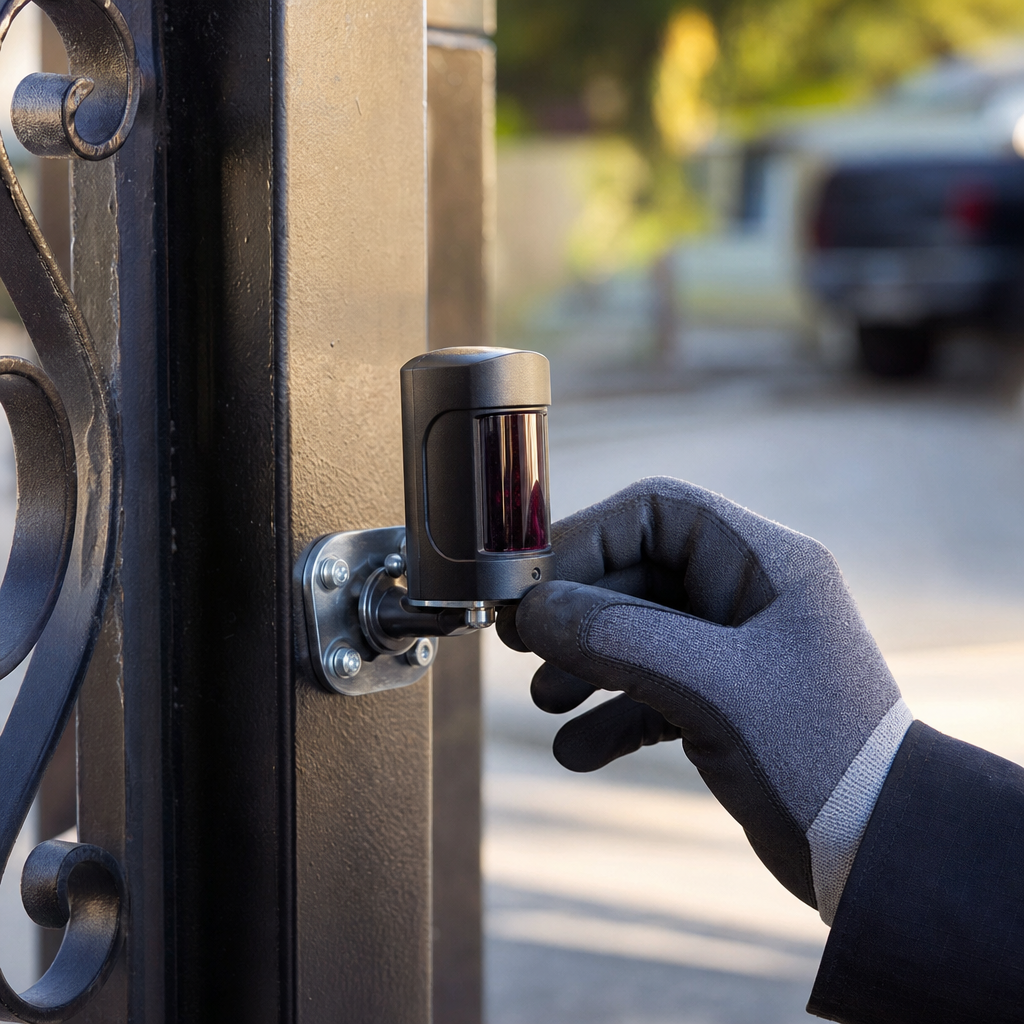
Different gate designs and property layouts rely on specific safety sensor configurations to protect pinch points and travel paths.
| Sensor Type | Operating Mechanism | Best Application | Common Failure Modes |
|---|---|---|---|
| Through-Beam Photo Eyes | Separate transmitter and receiver wired on opposite sides of the opening | Wide driveways, commercial facilities, high-traffic gates | Misalignment, terminal corrosion, cracked lenses |
| Retro-Reflective Sensors | Transmitter and receiver in one unit, bouncing off an opposite reflector | Tight driveways where running wire across the pavement is difficult | Reflector condensation, direct sunlight interference, debris |
| Monitored Edge Sensors | Pressure-sensitive rubber contact strips wired to gate edges | Slide gate leading edges, swing gate pinch points | Torn rubber sheathing, internal contact wear, broken coil cords |
Professional Diagnostics vs. Temporary Workarounds
Bypassing a safety eye with a direct wire jumper might get a gate moving temporarily, but it bypasses essential safety protections designed to prevent entrapment and injury. UL 325 standards require external non-contact or contact sensors used for entrapment protection to be monitored once every cycle for correct connection and operation. Proper gate sensor repair from providers such as Ironworks Gate Co. restores safety monitoring, corrects alignment, and ensures the operator functions reliably.[4]
Frequently Asked Questions About Gate Sensor Repair
Why is my automatic gate sensor blinking or not responding?
A flashing sensor LED usually means the optical beam is misaligned, the lens is blocked by dirt or condensation, or input voltage has dropped below the operating threshold. If the light does not turn on at all, the unit has lost power due to blown fuses, tripped surge protectors, or severed field wiring.
How much does it cost to repair or replace a gate safety sensor?
Photo eye realignment typically costs about $60 to $300, while photo eye replacement generally ranges from about $100 to $600.[2]
How do you align electric gate photo eye sensors properly?
To align through-beam sensors, loosen the mounting bracket screws slightly and aim the transmitter directly at the center of the receiver housing. Watch the diagnostic LED on the receiver unit; it will shift from a blinking state to a solid indicator once the beam connects cleanly. Fine-tune the horizontal and vertical axis before tightening down the hardware, ensuring the bracket cannot shift during normal gate operation.
Can a faulty gate sensor be repaired, or does it need full replacement?
As Ironworks Gate Co. notes, minor problems like lens dirt, physical misalignment, and surface corrosion on screw terminals can be repaired on-site. However, if internal circuitry has failed, if the infrared diode has weakened, or if the sensor is damaged beyond repair, full replacement is necessary.
How do I know if the problem is the sensor or the gate opener board?
If the photo-eye diagnostic light shows a solid alignment beam but the operator board still flashes an entrapment-protection error code, test the safety input terminals at the board using a multimeter. If the board fails to register state changes when the sensor beam is broken, the fault may lie within the control board circuitry rather than the sensor itself.
Sources
- Injury patterns and epidemiology of automatic door-related … – pubmed.ncbi.nlm.nih.gov (2026)
- [PDF] 2015 Annual Report – Consumer Product Safety Commission – cpsc.gov (2015)
- New Safety Standard for Automatic Security Gates Helps Prevent … – cpsc.gov (2000)
- [PDF] ANSI/CAN/UL 325 and Gate Installations – DASMA – dasma.com (2016)
Frequently Asked Questions
Is it safe to temporarily bypass a malfunctioning gate sensor to close my driveway gate?
Bypassing safety sensors with a jumper wire violates UL 325 safety standards and creates serious entrapment risks for vehicles and pedestrians. Instead of bypassing the safety circuit, disengage the operator using your manual key release and schedule a free on-site gate sensor repair assessment with Ironworks Gate Co.
How do technicians fix underground gate sensor wiring damaged by pests or landscaping?
Technicians use multimeters to test electrical continuity across direct-burial wire pairs, isolating severed conductors beneath the driveway. Ironworks Gate Co. can repair damaged runs on the first visit by splicing protected lines or pulling new low-voltage wiring through conduit to restore the safety circuit.
What should I do if my gate sensor fails after hours and leaves my gate stuck open or closed?
Use the mechanical release key on the gate arm or slide chassis to safely open the gate manually without damaging the motor. For urgent repairs, Ironworks Gate Co. provides 24/7 emergency dispatch and same-day diagnostics to restore your safety sensors with upfront pricing.
About the author
 |
Marcus Thorne Marcus Thorne is a security infrastructure specialist with over a decade of experience in automated gate systems and perimeter defense. Holding a degree in Mechanical Engineering from California State Polytechnic University, Pomona, he previously worked as a technical consultant for commercial property management firms across Southern California. Marcus focuses on providing clear, actionable advice on gate repair, maintenance costs, and security upgrades for residential and commercial properties. |
Gate not opening, off track, or opener dead?
We’re available now - call for a fast, free estimate.
Call Now - Free Estimate