
Quick Summary
Modern residential gate access control secures perimeter barriers by integrating mechanical gate operators with cellular, Wi-Fi, or hardwired credential validation systems for seamless property entry. Ironworks Gate Co. combines electrical precision and structural welding expertise to deliver tailored residential gate access control installations, safety sensor setups, and smart intercom retrofits. Property owners can schedule a free on-site gate assessment with Ironworks Gate Co. to receive an upfront written quote and select the ideal access configuration for their property.
Residential Gate Access Control: Secure and Fast Property Entry
Automating a residential perimeter requires balancing convenience, security, and physical reliability. As general market context, according to industry data from Dataintelo, residential applications accounted for $2.83 billion of the $8.7 billion global automated gate market in 2025. Modern entry systems offer remote access and monitoring, helping property owners regulate vehicle and pedestrian entry through a perimeter barrier.[1]
Whether managing a private residence, a multi-family property, or an estate, selecting an appropriate access configuration, as specialists at Ironworks Gate Co. note, helps ensure dependable gate operation.
What Is Residential Gate Access Control and How Does It Work?
Residential gate access control is the system of input devices, controllers, and software that manages entry through a physical barrier. Access control systems verify user credentials, evaluate permissions, and communicate with an electric operator to open the gate.[5]
General Access Sequence
A residential gate access control system typically follows a basic process:
- Credential Presentation: A visitor or resident presents an approved credential at the entry point.
- Credential Validation: The controller checks the input against authorized permissions.
- Gate Actuation: Once validated, the system signals the gate operator to open the barrier.
Cellular, Wi-Fi, and Hardwired Gate Entry Systems
Smartphone-based video intercoms and cloud-connected platforms are versatile residential gate access control solutions, providing homeowners with dependable entry management.[2]
| System Type | Network Connection | Primary Advantages | Main Considerations |
|---|---|---|---|
| Cellular Systems | Cellular network module | Independent of home internet; suitable for extended distances | Typically requires an active cellular service plan |
| Wi-Fi Systems | Local wireless network | Uses existing home network infrastructure | Signal strength may vary depending on distance and obstacles |
| Hardwired Systems | Direct wired connection | Consistent physical connection | Requires dedicated wiring runs between structures |
Cellular Gate Access Systems
Cellular systems use network modems at the gate location, allowing users to update access codes and manage entry remotely through mobile applications without relying on the home’s local Wi-Fi range.
Wi-Fi Connected Gate Systems
Wi-Fi access controllers connect directly to a local wireless network. They can be a practical solution for gates situated close to the main residence or near a dedicated outdoor access point.
Hardwired Telephone and Intercom Systems
Traditional hardwired systems connect through physical communication lines to dedicated indoor stations or telephone lines, providing a direct communication link to the property entrance, according to technical guides from Ironworks Gate Co.
Essential Components of an Electric Driveway Gate System
Need residential gate access control?
We’re available now - call for a fast, free estimate.
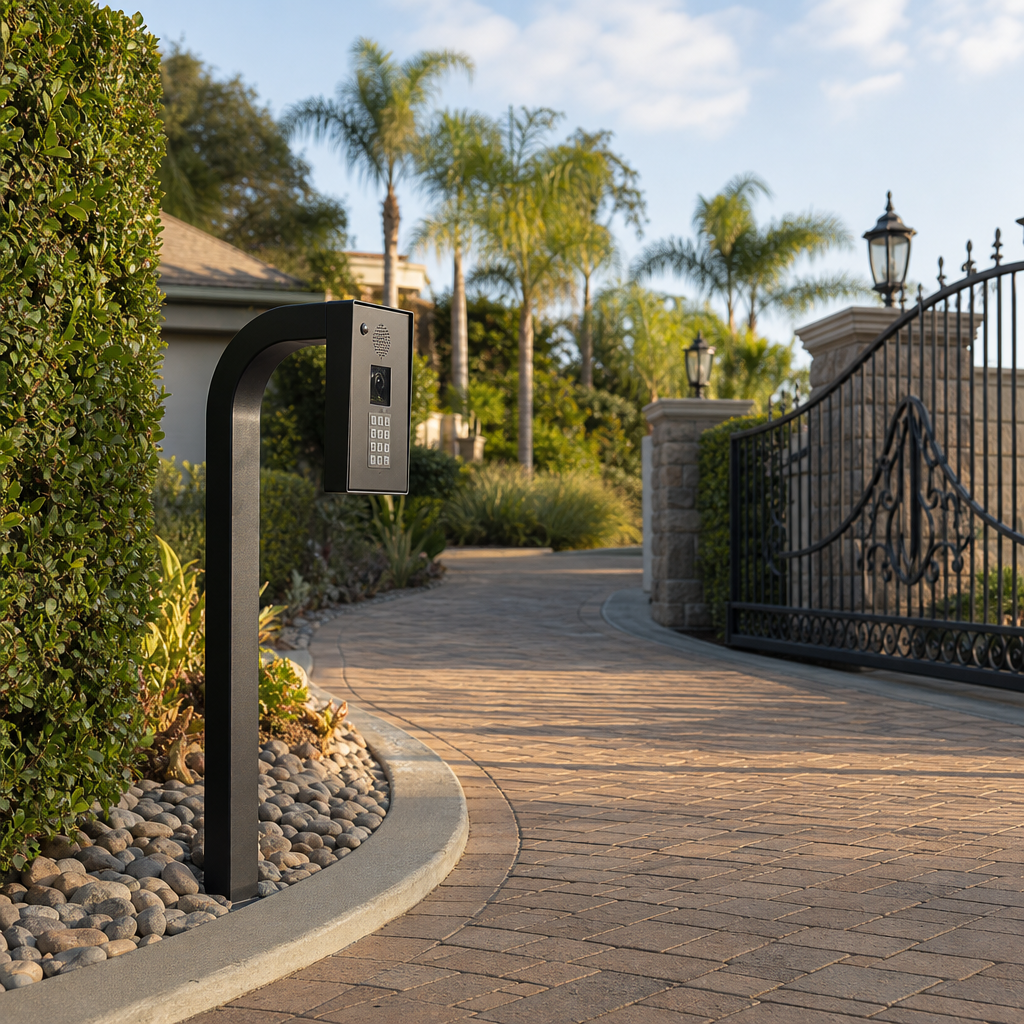
An automated gate setup generally consists of several core elements working together:
1. Gate Operators
The operator provides the mechanical movement for the gate, using swing or slide mechanisms suited to the specific driveway layout and gate style.
2. Safety Devices
Automated gate systems commonly integrate safety devices, such as infrared photo-eyes and vehicle detection loops recommended by Ironworks Gate Co., designed to detect obstacles in the gate path.
3. User Interfaces and Credential Readers
As broader market context, Grand View Research reported that the global residential smart lock market reached $3.4 billion in 2025. Residential driveway gates commonly use the following credential types:[3]
- Keypads
- Cards
- Mobile credentials
- License-plate recognition
Residential Gate Access Control Considerations and Cost Factors
As detailed by Ironworks Gate Co., the total investment for residential gate access control varies based on site conditions, communication infrastructure, hardware selection, and installation requirements:
- Basic Keypad and Receiver Systems: Typically represent entry-level configurations for standalone access.
- Connected Video Intercom Systems: Moderate investment covering controller units, intercom stations, and network setup.
- Full Automated Systems: Comprehensive installations including operator hardware, access control pedestals, safety sensors, and required wiring.
Frequently Asked Questions
What is the best access control system for a residential driveway gate?
Smartphone-based video intercoms and cloud-connected units are effective residential gate access control options. The best choice depends on site layout, distance from the residence to the gate, and user preference for cellular, Wi-Fi, or hardwired connectivity.[4]
Can I open and monitor my driveway gate using a smartphone app?
Yes. Connected gate controllers allow property owners to open, close, and monitor gate activity remotely via mobile applications.
How do intercoms integrate with automatic gate openers?
As installers at Ironworks Gate Co. explain, an intercom connects to the gate operator controller, sending an open signal when access is authorized by the resident or verified by the system.
What should I check if a gate stops moving or fails to close?
Common initial checks include ensuring safety sensors are clear of dirt or physical obstructions and verifying that the gate is not mechanically obstructed along its path.
Need residential gate access control?
We’re available now - call for a fast, free estimate.
Sources
- Automated Gate Systems Market Research Report 2033 – dataintelo.com (2033)
- Gate Operators Sales Market Research Report 2034 – dataintelo.com (2034)
- Automatic Gate Systems Market Research Report 2034 – dataintelo.com (2034)
- Explore the Global Residential Smart Lock Market – futuremarketinsights.com (2036)
- Residential Smart Lock Market Size & Share 2026-2035 – gminsights.com (2035)
Related reading: Licensed Driveway Gate Installers – Call Now-10% Off – Same-Day Service – Free Estimate
Related reading: Gate Motor Repair | Call Now-10% Off | On-Site in 60 Minutes | Free Estimate
Related reading: Electric Gate Motor Repair – Call Now-10% Off – On-Site in 60 Minutes – Free Estimate
Frequently Asked Questions
Can I add a modern access control system to an existing manual or legacy driveway gate?
Yes, legacy gates can be retrofitted with smart operators, wireless intercoms, and safety sensors without replacing the entire physical structure. Ironworks Gate Co. combines structural welding with electrical precision to reinforce existing gate frames and install seamless residential gate access control upgrades. Property owners can schedule a free on-site gate assessment to evaluate their setup and receive an upfront written quote.
How does a residential gate access control system operate during a power outage?
Most automated systems integrate battery backup units that keep credential readers, motor operators, and safety sensors functional during power disruptions. They also include manual mechanical key releases to ensure residents never get locked in or out of the property. Specialists at Ironworks Gate Co. can install or test dedicated battery backups and emergency bypass hardware for existing setups.
Which access control connection is best for driveways located far from the main house?
Cellular gate access systems are typically best for long driveways because they communicate over mobile networks without relying on Wi-Fi range or expensive trenching for hardwired lines. Wi-Fi systems work well for shorter runs, while hardwired setups provide interference-free stability if conduit already exists. Ironworks Gate Co. can test on-site connectivity and help you select the most dependable configuration for your property layout.
About the author
 |
Marcus Thorne Marcus Thorne is a security infrastructure specialist with over a decade of experience in automated gate systems and perimeter defense. Holding a degree in Mechanical Engineering from California State Polytechnic University, Pomona, he previously worked as a technical consultant for commercial property management firms across Southern California. Marcus focuses on providing clear, actionable advice on gate repair, maintenance costs, and security upgrades for residential and commercial properties. |
Gate not opening, off track, or opener dead?
We’re available now - call for a fast, free estimate.
Call Now - Free Estimate