
Quick Summary
When an electric gate stuck closed traps your vehicle, attempting to force it open manually can strip operator gears, bend drive arms, or create dangerous crush hazards. This guide from Ironworks Gate Co. outlines critical troubleshooting steps, including cutting electrical power, clearing obstructed photo-eye sensors, and properly engaging the manual release mechanism. Readers will gain the knowledge to safely restore driveway access and know when to contact Ironworks Gate Co. for same-day professional diagnosis and repairs on derailed or electrically failed gates.
Electric Gate Stuck Closed: Fast Steps to Open Now
When an electric gate stuck closed traps your vehicle inside the driveway, forcing it open by hand should never be your first move. Forcing an automated gate can strip operator gears, bend drive arms, or cause serious injury under stored mechanical tension. Before doing anything else, make sure the gate is completely stationary, turn off power at the dedicated breaker or isolation switch, and locate the manual release device designed for your specific operator model.[3]
While authoritative safety data measures automatic-gate injuries, entrapments, derailments, and safety defects rather than the narrower stuck-closed event, automated gates can become jammed closed for various mechanical and electrical reasons. Possible causes include physical binding, obstructions, or ground settling that places stress on the latch or arm. Follow this step-by-step troubleshooting guide from Ironworks Gate Co. to safely disengage your gate, identify what caused the lockup, and get moving again.[1] See also Commercial Gate Repair – 10% Off & Free Estimate – On-Site in 60 Minutes.
Quick Overview: What to Do When an Electric Gate Is Stuck Closed
Quick Action Summary: Turn off main power to the operator box. Check safety photo-eyes for leaves, cobwebs, or misalignment. If the system is safe to handle, use your manufacturer-supplied manual release key, hex tool, or disconnect pin to release the drive arm or chain carriage. Professional Help Threshold: Stop troubleshooting immediately and call a qualified professional if the gate resists manual movement, has derailed, is unstable, has fallen from its track, or presents a crushing or electrical hazard.
Immediate Action Checklist
- Stop hitting the remote or keypad: Repeatedly triggering a bound operator may cause motor or electrical strain; specific overload behavior is model-dependent and requires manufacturer documentation or professional diagnosis.
- Look for obvious sensor blocks: Automatic gates rely on safety sensors to prevent movement when beams are interrupted. Clear any dirt, spider webs, or overgrowth from the lenses.
- Kill the power supply: Shut off the breaker to prevent the motor from suddenly kicking on while your hands are near the mechanical drive.
- Locate the emergency manual release: Use the model-specific override key, disconnect lever, or tool to separate the gate leaf from the drive mechanism.
What You Need Before Troubleshooting a Stuck Gate
Working around heavy wrought iron, steel frames, and motorized hardware carries genuine pinch and crush hazards. Take a minute to grab the right basics before stepping up to the gate.
Tools and Gear to Have on Hand
- Heavy leather work gloves: Protects your hands from sharp iron scrollwork, rusted brackets, and pinch zones.
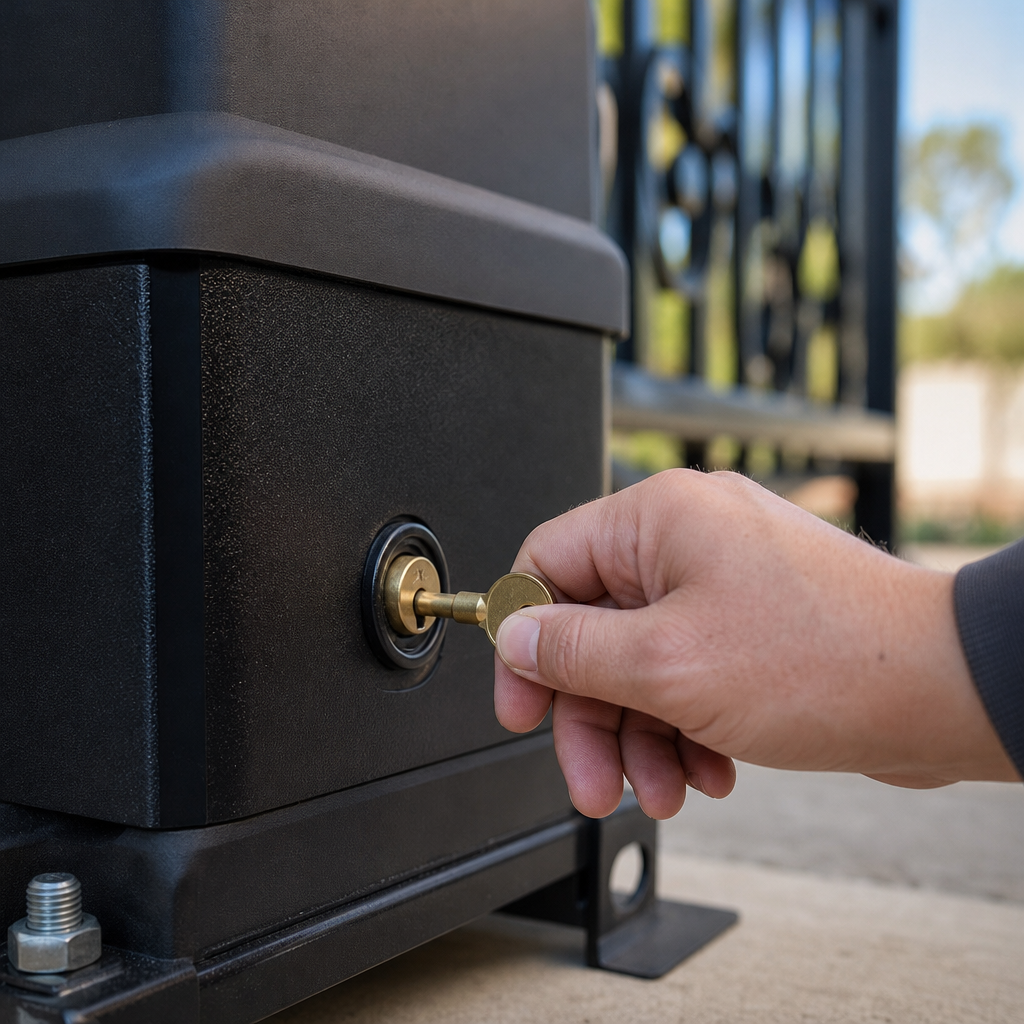
- The operator manual release tool: Depending on the brand (such as LiftMaster, DoorKing, Nice, or BFT), this could be a small brass key, a triangle key, an Allen wrench, or a simple release lever handle.
- Flashlight and clean microfiber cloth: Needed to inspect photo-eye alignment and wipe down dirty optical lenses.
- Level or measuring tape: Helpful to quickly verify if a support post or pilaster has shifted out of plumb.
Step 1: Verify Power Supply and Operator Status
Start by confirming whether the operator is receiving electrical current. Listen closely at the control housing. If you hear a quiet hum or click when sending a command, the board may be receiving a signal, but mechanical or electrical issues could prevent movement. If the box is completely silent and diagnostic status LEDs are off, check your subpanel for a tripped circuit breaker.
As Ironworks Gate Co. notes, keep in mind that high-voltage wiring and internal electrical components should only be tested by a trained gate technician. If the breaker instantly trips when reset, leave it off to prevent electrical damage.
Step 2: Check Photo-Eye Sensors and Optical Paths
Need electric gate stuck closed?
We’re available now - call for a fast, free estimate.
Automatic-gate safety standards include protective sensing mechanisms, such as obstruction reversal and secondary sensors (including photo-eyes and edge sensors). If an optical path is blocked or misaligned, the operator may prevent gate movement.[2]
Warning: Never bypass photo-eyes, edge sensors, or other safety devices.
Cleaning Lenses and Checking Alignment
Wipe the glass or plastic lenses on both sides of the driveway with a soft cloth. Look for moisture buildup, insect nests inside the sensor hood, or garden sprinklers that may have left a hard-water film over the beam path. Ensure the small indicator LED on the receiving sensor shows a solid alignment light rather than a rapid blink or no light at all.
Step 3: Inspect for Mechanical Torque Lock, Post Sag, and Derailment
Swing gates may lock shut due to mechanical torque lock. When gates are hung on posts or pilasters, ground settling, shifting masonry, or structural movement can cause posts to lean. That angle may wedge the locking pin tight against the receiver bracket or bind the actuator arm at its closed position.[4]
Recognizing Mechanical Binding
As specialists at Ironworks Gate Co. note, when torque lock or binding occurs, the gate motor may be unable to overcome the physical friction holding the gate leaf in place; specific overload or shutoff behavior is model-dependent and requires professional diagnosis. Sliding gates face similar mechanical obstacles, such as settling tracks, built-up debris, or seized bearings. If the gate has derailed, is unstable, or has fallen from its track, stop immediately, as this presents a crushing hazard requiring professional repair.
Step 4: Locate and Engage the Emergency Manual Release
Many powered gate operators provide a manual release system to disconnect the motor from the gate leaf during power outages or mechanical lockups. Because designs vary widely by manufacturer, you must follow the correct method for your unit.
Manual Release Procedure
To safely release the operator, confirm the gate is stationary, shut off power, consult the operator manual, and use the supplied keyed release, release hub, pin, tool, or lever as specified by the manufacturer.
Once disengaged, gently push the gate open by hand. If the gate resists manual movement, stop immediately; do not force it, as hardware binding or track derailment may be present.
Step 5: Check Wheels, Rollers, Tracks, and Hinges
If the motor is fully disengaged but the gate still refuses to swing or slide smoothly, the issue lies in the physical hardware. As outlined by Ironworks Gate Co., the following points are examples of potential trouble spots and require confirmation from the model manual or a qualified technician:
Hardware Inspection Checklist
- Hinges and Pivot Bearings: Examples include checking for cracked weld joints, metal shavings around the hinge barrel, or dry, ungreased roller bearings.
- V-Groove Tracks: Examples include checking for compacted gravel, dirt, or debris packed into the sliding track line.
- Guide Rollers: Examples include inspecting upper support rollers to verify whether they spin freely and remain properly aligned with the top frame tube.
Frequently Asked Questions About Electric Gates Stuck Closed
How do you manually open an electric gate with no power?
Confirm the gate is stationary, shut off power, consult the operator manual, and use the supplied keyed release, release hub, pin, tool, or lever as specified. Once released, manually push the gate open slowly while keeping hands clear of moving brackets and pinch points.
Why is my gate motor humming but the gate will not move?
A humming motor can indicate several possible issues, including mechanical resistance or torque lock at the latch or hinges, physical obstructions along the track, post or track misalignment, or internal component issues that require manufacturer documentation or professional diagnosis.
Where is the emergency manual release key located?
The manual release key or tool is usually supplied in the original installation packet from the manufacturer. On the machine itself, the release slot or mechanism is typically found behind an access panel on a slide operator or on the body of a swing arm operator.
What should I do if the gate is derailed?
If a gate has derailed, is unstable, or has fallen from its track, do not attempt to force it back into place. Heavy gates can tip over, creating a severe crush hazard. Stop troubleshooting, secure the area, and call a professional repair technician, such as Ironworks Gate Co., to service the system.
Need electric gate stuck closed?
We’re available now - call for a fast, free estimate.
Sources
- 2024-11-20-COPF-CODD-Hummingbird-Alliance-Meeting- … – cpsc.gov (2024)
- New Safety Standard for Automatic Security Gates Helps Prevent … – cpsc.gov (2001)
- Standards for the Hidden Dangers of Gates – ASTM – astm.org (2024)
- Surveys reveal top design flaws negating safety of a swing gate – gate-safe.org (2023)
Related reading: How to Open Sliding Gate Manually | 10% Off & Free Estimate | Same-Day Service
Related reading: Reset Gate Motor | 10% Off & Free Estimate | Same-Day Service
Frequently Asked Questions
What should I do if my electric gate is stuck closed and I lost the manual release key?
If you cannot locate your manual release key, avoid using force or makeshift tools that could strip internal operator gears or bend the drive linkage. Call Ironworks Gate Co. for same-day emergency dispatch, as our technicians carry specialized override tools and replacement keys for all major operator brands.
Why does my electric gate circuit breaker keep tripping when the gate tries to open?
A breaker that trips immediately usually points to an internal short circuit, moisture inside the control housing, or a seized motor drawing excessive amperage. Leave the breaker turned off to prevent electrical damage and contact Ironworks Gate Co. for a professional diagnosis and upfront-priced repair.
How do technicians fix an electric gate stuck closed due to post sag or torque lock?
When shifting soil or structural movement wedges the gate latch tight against the receiver, technicians must safely relieve physical tension before servicing the hardware. Ironworks Gate Co. resolves torque lock by releveling structural posts, realigning heavy-duty hinges, and recalibrating limit switches to prevent future binding.
About the author
 |
Marcus Thorne Marcus Thorne is a security infrastructure specialist with over a decade of experience in automated gate systems and perimeter defense. Holding a degree in Mechanical Engineering from California State Polytechnic University, Pomona, he previously worked as a technical consultant for commercial property management firms across Southern California. Marcus focuses on providing clear, actionable advice on gate repair, maintenance costs, and security upgrades for residential and commercial properties. |
Gate not opening, off track, or opener dead?
We’re available now - call for a fast, free estimate.
Call Now - Free Estimate