
Quick Summary
When an automatic gate is not opening, property access and security are instantly disrupted by underlying causes ranging from tripped breakers and dirty photo-eyes to severe structural binding. As a trusted regional expert, Ironworks Gate Co. provides professional diagnostics to resolve dangerous electrical motor faults, control board failures, and mechanical track resistance safely. Property owners can perform basic external checks and call for 24/7 live dispatch or book a free on-site assessment for same-day diagnostic and repair service.
Automatic Gate Not Opening: Fast Diagnostics & Repair
When you press your remote and your automatic gate is not opening, your driveway becomes an immediate bottleneck. Cars get trapped inside, delivery drivers turn around, and your property is stuck without its primary security perimeter. Getting it moving again starts with understanding possible causes of the stall, whether it is an electrical feed interruption, an activated safety circuit, or physical binding in the gate hardware. Exact diagnosis depends on the operator model and inspection.
A gate system relies on a balance between motor controls, optical safety eyes, and physical structural alignment. While simple issues like dead remote batteries or an interrupted power supply may be quick to identify, specialists such as Ironworks Gate Co. note that frequent motor stalls often point to deeper mechanical friction or structural issues that need professional inspection. See also Commercial Gate Repair – 10% Off & Free Estimate – On-Site in 60 Minutes.
Quick Diagnostics: What to Do When Your Automatic Gate Is Not Opening
Before proceeding, work through safe external observations to separate electrical supply problems from mechanical resistance.
Immediate Safety and Triage Checklist
If your electric gate won’t open, run through these baseline checks:
- Check power availability: Verify whether main power is available to the system at the breaker or disconnect switch.
- Inspect safety sensors: Check optical sensor cleanliness and alignment according to the operator manual, clearing away dirt, cobwebs, or debris from the lens faces.
- Look for visible track or hinge obstructions: Check along the ground track or swing path for trapped debris or visible signs of binding.
Safety should always come first. Research from Gate Safe in a 2024 survey showed that over 90% of 114 surveyed commercial automated gates were classified as unsafe due to installation or safety device issues. Note that available research does not establish a verified failure-rate percentage for automatic gates not opening in Huntington Park, Los Angeles County, California, or the United States. An automated gate is a heavy moving machine that can cause serious injury if forced.[1]
Top Three Immediate Action Items
- Verify that electrical power is available, and replace remote transmitter batteries.
- Check indicator lights only as described in the manufacturer’s manual; inspect for dirt, damage, blocked beam paths, loose wiring, or misalignment.
- Check the path of travel for visible physical obstructions before attempting to operate the system again.
Common Automatic Gate Failures and Diagnostic Paths
Gates may fail to complete an opening cycle when power is interrupted, a travel limit is reached, or a safety device such as a photocell or pressure edge is activated. Physical track binding, roller bearing wear, or structural post deflection are also possible causes of a stall, though exact diagnosis depends on the operator model and inspection.
Symptom to Component Matrix
| Observed Symptom | Electrical System | Safety Devices | Structural / Hardware |
|---|---|---|---|
| Motor hums, gate does not move | Possible power feed or capacitor issue | Circuit clear | Possible mechanical binding or seized hardware |
| Clicking relay, silent motor | Control board receiving signal | Possible active safety sensor lockout | Hardware stationary |
| Complete power loss, no lights | Possible tripped breaker, blown fuse, or power drop | Unpowered | Hardware stationary |
DIY Safety Limits vs. Professional Mechanical Intervention
Homeowner checks must be limited to safe external observations, such as checking whether power is available, replacing a remote battery, clearing visible obstructions, and checking sensor cleanliness and alignment according to the operator manual. Never bypass photocells, pressure edges, entrapment protection, or any other safety devices. Always call for professional service for electrical panels, internal wiring, control boards, mechanical binding, and structural repairs.
According to data from the California Department of Occupational Safety and Health (reported through ASTM International), 47 work-related accidents occurred between 1990 and 2024 involving horizontal sliding gates falling or derailing, injuring 35 workers and killing 12. Gate Safe advises that all automated gate systems receive professional maintenance at least every six months, with more frequent checkups for high-cycle properties. If you hear loud grinding or the gate frame is physically out of plumb, call a licensed technician.[2]
1. Power Supply Failures and Tripped Breakers: Checking Electrical Feeds
A sudden power interruption is a common possible cause when an automated gate does not respond. Exterior wiring and disconnects are constantly exposed to weather and environmental conditions.
Subpanel Breakers and High-Voltage Disconnects
When the system shows no signs of power, perform these safe external checks:
- Locate your main electrical panel or dedicated subpanel to check whether a breaker has tripped.
- Check the exterior disconnect switch near the operator to confirm it is in the ON position.
- Check any external GFCI outlets tied into the gate supply to verify they have not tripped.
Environmental Factors and Electrical Faults
Outdoor conduit runs, especially those running along masonry walls or buried in shallow trenches, are prone to moisture intrusion. Gate Safe reported that 84% of surveyed installers considered unsafe design the most common cause of automated-gate accidents during the previous 10 years. When dealing with electrical panels, high-voltage lines, or internal control wiring, leave all diagnostics and repairs to qualified professionals.[5]
2. Misaligned Safety Photo-Eyes: Clearing Sensor Lockouts and Obstructions
Need automatic gate not opening?
We’re available now - call for a fast, free estimate.
Modern gate operators rely on infrared photo-eyes and other safety devices to monitor the opening. If an optical beam is broken or misaligned, the control system prevents gate movement to protect against entrapment.
Infrared Optical Alignment and Sensor Diagnostics
Safety devices save lives. Gate Safe recorded 14 additional incidents involving automated gates without appropriate safety measures, including seven fatalities. When evaluating sensors:[3]
- Check indicator lights only as described in the manufacturer’s manual; inspect for dirt, damage, blocked beam paths, loose wiring, or misalignment.
- Verify that sensor brackets are securely fastened and clean according to the operator instructions.
- Never attempt to bypass, disconnect, or bridge safety sensor circuits.
Environmental Interference: Dust, Debris, and Sunlight
Spiderwebs inside sensor hoods, mud splattered from rain, or blowing yard debris can interrupt an infrared beam. Low-angle sunlight hitting a receiver lens can also cause temporary interference. Wiping lenses clean with a soft cloth according to the manufacturer’s manual can resolve false obstruction readings.
3. Remote Control and Access Device Errors: Resolving Signal Drops
When a gate responds to a hardwired station but fails to respond to a handheld remote, possible causes include transmitter battery depletion or radio frequency interference.
Transmitter Batteries and Signal Issues
Test your handheld transmitters safely: replace the battery first, and verify whether a backup remote operates the gate. Check that the external antenna wire is intact and not obstructed. Exact radio diagnosis depends on the operator model and receiver setup.
Keypad, Intercom, and Hardwired Station Failures
If access controls fail to operate the gate, internal wiring or receiver boards may require professional service. The U.S. Consumer Product Safety Commission noted over 25,000 automatic gate injuries between 1990 and 2000, underscoring why access systems and safety circuits must always remain fully operational and never be bypassed.[4]
4. Structural Movement and Mechanical Binding: Uncovering Hidden Stalls
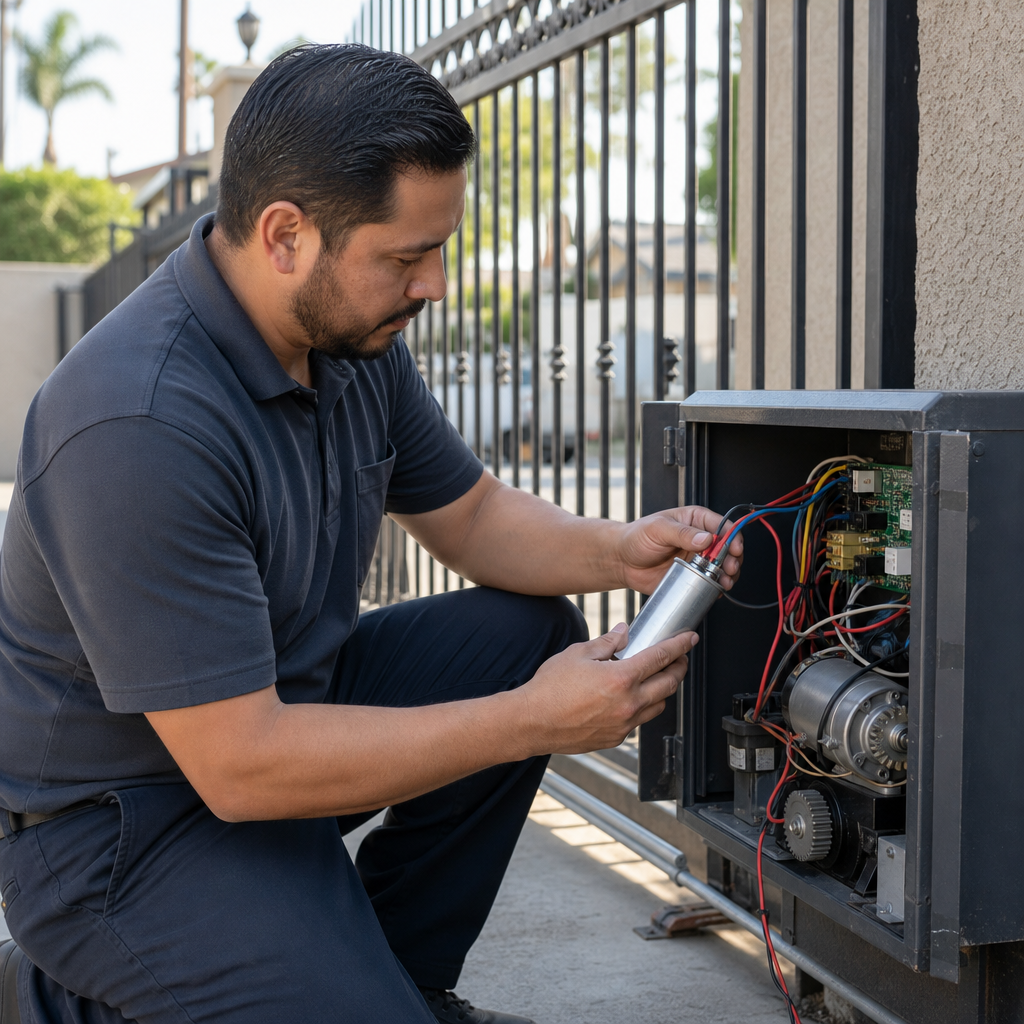
A gate that fails to open may be experiencing structural movement or mechanical binding rather than a motor failure, though exact diagnosis depends on the operator model and physical inspection.
Structural Movement and Shifting Geometry
Ground settling, soil expansion, or structural post movement can cause gate support posts to tilt. When the gate drops out of square or alignment, the motor encounters excessive mechanical resistance.
Torque-Lock and Resistance Stalls
When a gate arm or track binds, the motor draws excess amperage, which may trigger an internal overload stop. As technicians at Ironworks Gate Co. point out, correcting structural sagging, hinge alignment, and post stability requires professional mechanical repair.
5. Motor and Control Board Diagnostics: Resolving Operator Stalls
If power is available and safety devices are clear, potential faults within the operator housing may be responsible.
Motor Issues and Run Capacitors
If a gate motor hums but fails to move the hardware, a failed run capacitor, mechanical seizure, or motor winding fault are possible causes. Exact diagnosis requires professional testing of electrical components.
Control Board Relays and Circuit Boards
Power surges, thermal cycling, and component wear can damage relays and circuitry on the main control board. If the control board clicks but the motor does not engage, professional board-level testing or replacement is advised.
6. Mechanical Track, Roller, and Hinge Seizure: Clearing Physical Obstacles
Need automatic gate not opening?
We’re available now - call for a fast, free estimate.
Physical hardware wear and track obstructions are frequent possible causes of sudden gate stalls on sliding and swing installations.
Track Obstructions and Roller Wear
Sliding gate tracks can accumulate gravel, compacted soil, and debris. Inspect the track length visually and clear any loose obstructions. Worn or seized roller bearings can also cause significant resistance, requiring hardware replacement by a technician.
Hinge Condition and Hardware Maintenance
Swing gates place heavy loads on hinges. Dry or worn hinge bearings create friction that can prevent an operator from completing its stroke. Periodic lubrication according to manufacturer recommendations helps maintain smooth mechanical operation.
7. Emergency Manual Release Procedures: How to Safely Disengage Your Gate
When power is interrupted or an operator requires manual disengagement, proper safety protocols must be followed.
Operating the Emergency Manual Release
Follow these supported steps to manually disconnect your gate:
- Isolate power: Turn off electrical supply to the operator at the breaker or dedicated disconnect to ensure the system cannot activate unexpectedly.
- Ensure the gate is stopped: Verify that the gate is completely stationary before touching release mechanisms.
- Use the designated emergency-release mechanism: Disengage the operator according to the manufacturer’s instructions using the provided key or release handle.
- Do not force the gate: Move the gate gently by hand; never force a gate that resists movement, as it may be bound or derailed.
- Keep clear of hazards: Keep hands, clothing, and bystanders clear of moving parts, pinch points, hinges, and guide rollers.
Safety Precautions for Manual Disengagement
Exercise caution on sloped driveways, where an unlatched gate may swing or roll freely under gravity. Maintain a firm grip and stand clear of the gate’s travel path.
8. Gate Operator Diagnostics and Troubleshooting Protocols
Modern commercial and residential gate operators feature onboard diagnostic indicators and status displays to assist in identifying system faults.
Manufacturer Diagnostics and Documentation
When reviewing diagnostic indicators, consult the specific manufacturer’s manual for your operator model. Error codes and indicator light patterns vary significantly by brand and model.
Professional Diagnostic Protocols
Trained gate technicians, such as those from Ironworks Gate Co., utilize specialized meters to measure line voltage, capacitor ratings, and safety-loop continuity. Professional recalibration ensures the gate system complies with current safety standards.
9. Repair Considerations for Automatic Gates
Repair requirements depend on whether the issue involves basic sensor alignment, electrical component replacement, or structural hardware realignment. Exact requirements and scope of work depend on the specific operator model, installation design, and site conditions upon professional inspection.
Repair vs. Complete Operator Replacement Decision Guide
If your gate operator is in good physical condition and replacement parts are available, repairing discrete electrical or mechanical components is often feasible. However, if the operator lacks modern entrapment protection devices, has sustained extensive water intrusion, or lacks manufacturer parts support, upgrading to a modern, safety-compliant system is recommended.
Frequently Asked Questions About Automatic Gates That Will Not Open
Here are direct answers to common questions property owners face when an automated driveway gate refuses to operate.
Why is my automatic gate not opening with the remote?
Possible causes include a dead transmitter battery, antenna obstruction, or radio receiver issues. Start by replacing the remote battery and testing with a backup remote.
How do I manually open an automatic gate when power is out?
Isolate power to the unit, ensure the gate is stopped, and use the designated emergency-release mechanism according to the manufacturer’s instructions. Never force the gate and keep clear of pinch points.
Why is my electric gate humming or clicking but not moving?
Possible causes include a failed motor capacitor, control board relay issue, or mechanical binding in the hinges or track. Exact diagnosis depends on the operator model and inspection.
How do I know if my gate sensor or safety eye is faulty?
Check indicator lights only as described in the manufacturer’s manual; inspect for dirt, damage, blocked beam paths, loose wiring, or misalignment. Never bypass or bridge safety sensors.
What should I check before calling a professional gate repair contractor?
Limit checks to safe external observations: confirm that power is available at the breaker, replace remote batteries, clear visible debris from the gate track, and check sensor cleanliness and alignment per the manual.
Need automatic gate not opening?
We’re available now - call for a fast, free estimate.
Sources
- FRA safety data – Department of Transportation – safetydata.fra.dot.gov (2024)
- Petition File No. 605 Proposed Decision – dir.ca.gov (2024)
- 2024-11-20-COPF-CODD-Hummingbird-Alliance-Meeting- … – cpsc.gov (2024)
- New Safety Standard for Automatic Security Gates Helps Prevent … – cpsc.gov (2001)
- Gate Accidents – The needless loss of life continues – gate-safe.org (2022)
Related reading: Electric Gate Not Working After Power Outage | Call Now-10% Off | Same-Day Service | Free Estimate
Related reading: Reset Gate Motor | 10% Off & Free Estimate | Same-Day Service
Related reading: How to Open Sliding Gate Manually | 10% Off & Free Estimate | Same-Day Service
Frequently Asked Questions
How can I tell if my gate failure is caused by mechanical binding rather than a motor fault?
You can isolate the issue by safely disengaging the emergency release and moving the gate manually. If the gate resists, sticks, or grinds, structural sagging, worn rollers, or track binding are likely the cause. If it glides smoothly by hand, specialists from Ironworks Gate Co. can test for electrical motor, capacitor, or control board failures.
Why does my automatic gate refuse to open after heavy rain or cold weather?
Rainwater can enter unsealed conduit lines to trip GFCI breakers or fog safety photo-eye lenses, while cold temperatures can thicken hinge grease and increase motor resistance. If cleaning external lenses and checking breakers does not restore operation, Ironworks Gate Co. provides same-day diagnostics to inspect internal electrical housings safely.
How often should an automated gate undergo professional maintenance to prevent sudden opening failures?
Safety standards recommend professional inspections at least once every six months, with more frequent checkups for high-cycle commercial properties. Routine service from Ironworks Gate Co. verifies sensor alignment, measures motor electrical loads, and lubricates mechanical components to prevent unexpected access lockouts.
About the author
 |
Marcus Thorne Marcus Thorne is a security infrastructure specialist with over a decade of experience in automated gate systems and perimeter defense. Holding a degree in Mechanical Engineering from California State Polytechnic University, Pomona, he previously worked as a technical consultant for commercial property management firms across Southern California. Marcus focuses on providing clear, actionable advice on gate repair, maintenance costs, and security upgrades for residential and commercial properties. |
Gate not opening, off track, or opener dead?
We’re available now - call for a fast, free estimate.
Call Now - Free Estimate