
Quick Summary
Regular sliding gate maintenance is essential for preventing motor strain, hardware wear, and entrapment hazards caused by daily traffic vibration and environmental debris. Maintaining dry, ungreased ground tracks alongside properly aligned sensors and secure positive-stops ensures reliable operation, with Ironworks Gate Co. providing advanced mechanical tune-ups and hardware inspections. Readers will gain a clear checklist for basic property upkeep and understand when to schedule a professional sliding gate tune-up or safety assessment.
Sliding Gate Maintenance: Safety Checks and Service Guidance
A sliding gate provides security and convenience until it sticks halfway across the driveway, grinds against the track, or refuses to move. In dense neighborhoods and industrial corridors, heavy traffic vibration and coastal air put steady stress on rolling hardware, motor assemblies, and track foundations. Performing routine sliding gate maintenance keeps your system moving freely and prevents premature motor wear.
Automated entry systems operate under mechanical tension. Consumer Product Safety Commission (CPSC) information identifies entrapment, crushing, and impact hazards associated with automatic gates, and reported incidents associate failed or missing end-stops, positive-stops, and certain hardware failures with injuries. Keeping these systems safe requires regular track clearing, hardware inspections, and timely professional service from experienced providers like Ironworks Gate Co.[1] See also Commercial Gate Repair – 10% Off & Free Estimate – On-Site in 60 Minutes.
Warning: Stop using the gate and obtain qualified service if safety devices fail, the gate behaves unpredictably, or structural or electrical defects are suspected.
Sliding Gate Maintenance Overview: Key Safety and Operating Factors
Electric sliding gate maintenance focuses on three core elements: reducing rolling resistance, maintaining positive physical stops, and keeping safety sensors aligned. When rolling friction increases, the operator motor draws extra amperage to push the gate leaf, causing internal drive components to wear out early.
Follow the manufacturer’s maintenance schedule, perform routine checks, and arrange a formal inspection at least annually for automated systems.
The Real Danger of Track Grease in Urban Corridors
One of the most common maintenance mistakes property owners make is applying wet lubricants or thick grease directly onto open ground tracks. In dry, dusty environments or near heavy traffic routes, sticky grease acts as a magnet for grit, sand, and debris.
As the bottom rollers ride over this buildup, the mixture wears down the wheel bearings and track surfaces, forcing the motor to fight severe rolling resistance. Sliding gate track cleaning should always leave the running rail clean and dry. Use only the lubricant specified by the gate and operator manufacturer, and apply it only to components identified in the manual.
The Essential Sliding Gate Maintenance Checklist
Before performing any inspection, locate your manual release key so you know how to manually open automatic gate systems if power is cut. Perform routine checks including:[2]
- Keep ground rails dry and clean: Sweep dirt, gravel, and leaves away from the track path.
- Test manual gate resistance: Disengage the motor clutch and push the gate by hand. It should glide smoothly with minimal effort and no sticking points.
- Inspect physical positive-stops: Check that stop blocks at both ends of travel are secure, intact, and able to stop gate travel as designed.
- Wipe optical sensors: Clean dust, spider webs, and residue off photo-eye sensor lenses.
- Check drive linkages: Inspect roller chains or gear racks for proper tension, alignment, rust, and tooth wear.
User Upkeep vs. Professional Servicing
Property owners can handle basic surface cleaning and visual checks. However, when an electric gate is not working properly due to electrical faults or structural sag, calling a technician prevents injury and equipment damage.
| Maintenance Task | Property Owner Upkeep | Professional Gate Technician |
|---|---|---|
| Track and Ground Rail | Sweep loose dirt and clear surface grime | Measure track deflection, levelness, and anchor stability |
| Rollers and Bearings | Listen for grinding noises and inspect for flat spots | Replace internal bearings, re-align tandem wheel carriages |
| Safety Devices | Wipe lenses and clear plant overgrowth | Perform entrapment protection tests and sensor circuit diagnostics |
| Motor and Drive Gear | Keep housing clear of insect nests and debris | Test capacitor draw, adjust clutch torque, and reset limit switches |
| Positive-Stops and Posts | Visual check for loose hardware or damaged stops | Repair structural mountings, reinforce pilasters, and realign posts |
1. Dry-Track Cleaning and Track Deflection Testing
Need sliding gate maintenance?
We’re available now - call for a fast, free estimate.
Ground tracks installed across driveways take constant punishment from vehicle tires. When heavy vehicles roll over an unsupported rail, the track flexes. Over time, concrete anchors can loosen, creating dips that cause the gate to bind.
How to Clean Driveway Tracks Properly
- Use a stiff brush to loosen packed dirt, road grime, and debris from the V-groove or round pipe track.
- Sweep or vacuum the entire run of the track, paying close attention to the area where the gate rests when fully open.
- Never apply wet grease or unapproved lubricants to the top of the rail. The track must remain dry and clean.
Measuring Track Deflection and Level
Technicians from Ironworks Gate Co. perform load testing to ensure the track does not bow excessively under the gate’s weight. If the rail dips or becomes unlevel, the bottom rollers can bind, causing the drive motor to stall as it attempts to move the gate.
2. Sliding Gate Roller Lubrication and Bearing Checks
Worn or seized rollers are a primary cause of sliding driveway gate operating issues. Modern sliding gates rely on wheels fitted with internal bearings.[4]
Recognizing Worn Rollers
When rollers begin to fail, you may hear grinding noises or rhythmic thumping as the gate travels. Disengage the operator and roll the gate by hand. If the gate feels heavy, jerks, or shows flat spots along the wheel tread, the bearings may have collapsed.
Correct Roller Lubrication
Use only the lubricant specified by the gate and operator manufacturer, and apply it only to components identified in the manual.
3. Safety Sensor Alignment and Obstruction Testing
When an automatic gate will not close, misaligned or dirty photo-eye sensors are often the cause. Safety sensors cast an infrared beam across the driveway opening; if the beam is broken, the gate stops or reverses automatically to help prevent impact hazards.[5]
Environmental Sensor Hazards
Near coastal areas, fog and salt air leave mineral residue on sensor lenses. In inland areas, dust and lawn sprinklers cause spotting. Direct sunlight hitting the receiving eye can also interfere with the sensor, causing the control board to detect an obstruction.
Cleaning and Aligning Photo-Eyes
- Wipe the lenses clean with a soft cloth and an appropriate cleaner.
- Check the indicator lights according to the manufacturer’s manual to ensure proper alignment.
- Tighten the mounting bracket screws to ensure the sensors remain securely in position.
4. Inspect Positive-Stops and Travel Limits
Need sliding gate maintenance?
We’re available now - call for a fast, free estimate.
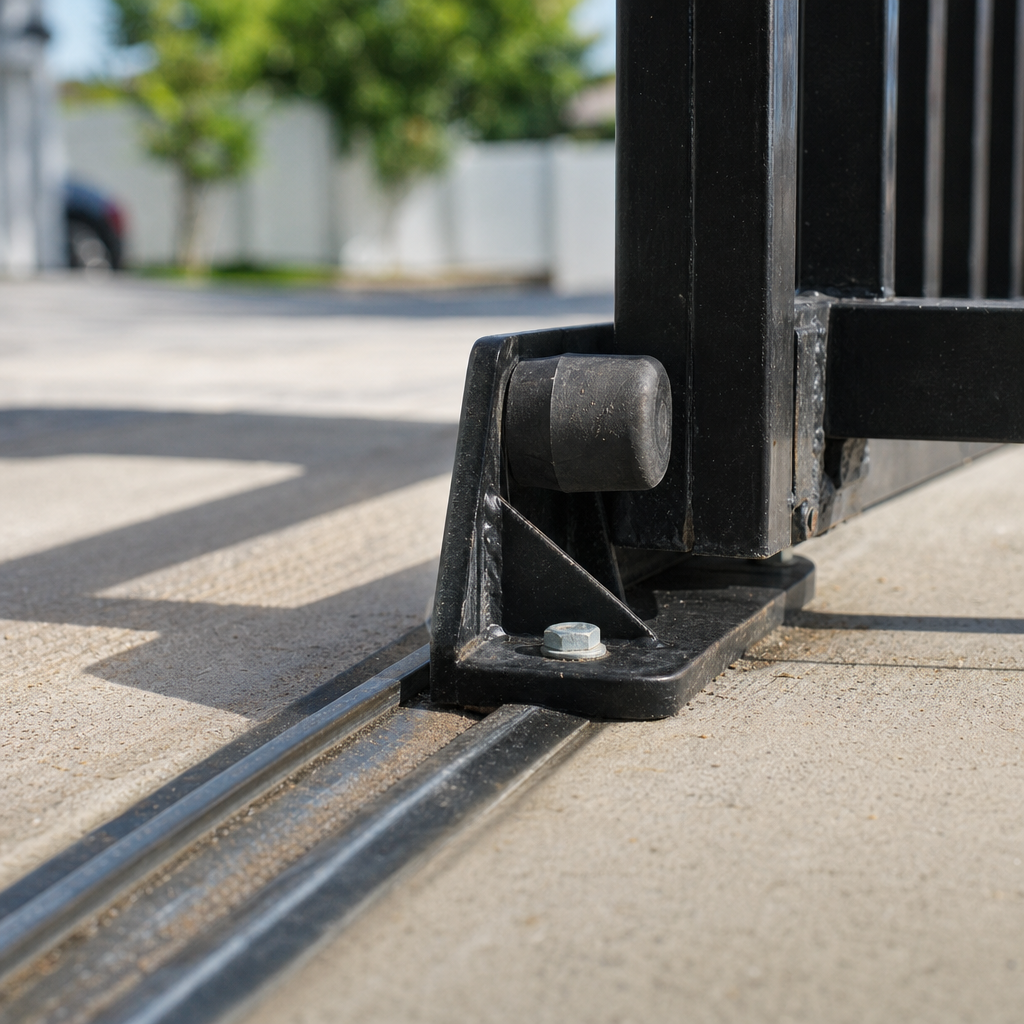
Electronic limit switches tell the motor when to stop, but physical positive-stops prevent the gate panel from rolling off the end of the track if electronic limits fail.
CPSC information identifies entrapment, crushing, and impact hazards, and reported incidents associate failed or missing end-stops, positive-stops, and certain hardware failures with injuries.[3]
Inspecting Mechanical End-Stops
- Inspect the physical stop blocks at both ends of the track. Ensure they are secure, intact, and able to stop gate travel as designed, and free of deep rust.
- Examine the top guide rollers and catch brackets. The gate leaf must stay captured inside the guide assembly throughout its entire travel path, especially when contacting the physical stop.
- Verify that rubber bumper pads on the stops are intact to soften mechanical contact.
5. Sliding Gate Opener Maintenance and Drive Linkages
Your gate operator contains an electric motor, reduction gearbox, control board, and drive chain or rack. Neglecting these drive components can lead to broken chains, stripped gears, and electrical faults.
Drive Chain and Rack Care
On chain-driven operators, check chain sag and tension. An excessively tight chain places heavy side-load on the operator output shaft, while a loose chain can slip off the drive sprocket. Use only the lubricant specified by the gate and operator manufacturer, and apply it only to components identified in the manual.
On rack-and-pinion operators, inspect the gear rack mounted along the gate. Ensure the pinion gear teeth mesh cleanly with the rack with appropriate clearance along the full gate travel.
Protecting the Control Box
Open the operator cabinet and check for signs of moisture intrusion, pests, or nesting. Clean away debris and inspect electrical terminals for corrosion. In hot or humid climates, inspect motor capacitors for signs of damage or leaks.
6. Structural Posts, Foundations, and Pilaster Alignment
A gate system depends on the foundation supporting it. Heavy gates mounted on aging posts or pilasters can pull anchors loose over time. Ground settling and vibrations can also cause mounting posts to shift out of plumb.
Checking Structural Plumb
Use a level against both main support posts. If a post leans, the gate leaf can bind inside the top guide rollers or fail to engage the catch bracket properly. Shifting soil or cracked concrete footings should be addressed by a qualified professional.
Frequently Asked Questions About Sliding Gate Maintenance
How often should a sliding driveway gate be serviced?
Follow the manufacturer’s maintenance schedule, perform routine checks, and arrange a formal inspection at least annually for automated systems.
What is the best lubricant for sliding gate rollers and tracks?
Use only the lubricant specified by the gate and operator manufacturer, and apply it only to components identified in the manual. Ground tracks must remain clean and dry.
How do I keep my automatic sliding gate track clear of debris?
Sweep the track regularly with a stiff broom and inspect the travel path and end pockets for leaves, gravel, and trash. Keep surrounding soil or gravel graded away from the rail to prevent runoff onto the track.
What are the most common signs a sliding gate motor or roller is failing?
Early warning signs include grinding or squealing noises, a motor that hums without moving the gate, jerky panel movement, slower travel speeds, or a gate that stops and reverses unexpectedly.
Can homeowners do DIY sliding gate maintenance or is a technician needed?
Property owners can safely handle cleaning tracks, wiping photo-eyes, clearing debris, and checking manual movement. High-voltage electrical repairs, control board replacements, torque adjustments, structural repairs, and track realignment should be handled by a qualified gate service professional, such as Ironworks Gate Co.
How much does professional sliding gate maintenance and tune-up cost?
The cost of professional sliding gate maintenance depends on the system type, size, and overall condition. Standard servicing typically includes comprehensive safety inspections, travel limit adjustments, and sensor alignment. If worn rollers, damaged sensors, or electronic components require replacement, additional parts and labor will be necessary.
Need sliding gate maintenance?
We’re available now - call for a fast, free estimate.
Sources
- Petition File No. 605 Cal/OSHA Evaluation – dir.ca.gov (2024)
- New Safety Standard for Automatic Security Gates Helps … – CPSC – cpsc.gov (2001)
- Safety Standard for Gates and Enclosures – federalregister.gov (2020)
- FR-2020-07-06.xml – govinfo.gov (2020)
- [PDF] Investigation Guideline Product: Automatic Gate Operators Appendix – reginfo.gov (2000)
Related reading: Automatic Gate Not Opening | Call Now-10% Off | Same-Day Service | Free Estimate
Related reading: Electric Gate Not Working After Power Outage | Call Now-10% Off | Same-Day Service | Free Estimate
Related reading: Diy Gate Repair – 10% Off & Free Estimate – On-Site in 60 Minutes
Frequently Asked Questions
What should I do if my sliding gate comes off its track?
Immediately switch off the main power or disengage the motor clutch to prevent motor burnout and stop further track damage. Never attempt to force or lift a heavy, derailed gate leaf alone due to severe tip-over and crushing hazards. Contact the specialists at Ironworks Gate Co. to inspect top guide rollers, correct track deflection, and safely reset the assembly.
How do I safely test my sliding gate auto-reverse safety feature?
Place a lightweight, non-damaging obstruction such as a large cardboard box in the closing path and activate the gate. A properly calibrated system should instantly reverse or stop upon breaking the photo-eye beam or contacting the obstacle. If your gate continues to push through, stop automated use immediately and schedule a professional safety assessment to prevent entrapment accidents.
Why is my sliding gate motor humming but failing to move the gate?
A humming motor typically points to a failing capacitor, low voltage delivery, or mechanical resistance from seized roller bearings. Disengage the manual release key and push the gate by hand to determine if the panel is physically binding along the rail. If the gate rolls smoothly manually, the issue lies within the operator gearbox or electrical drive components, requiring professional diagnostic service.
About the author
 |
Marcus Thorne Marcus Thorne is a security infrastructure specialist with over a decade of experience in automated gate systems and perimeter defense. Holding a degree in Mechanical Engineering from California State Polytechnic University, Pomona, he previously worked as a technical consultant for commercial property management firms across Southern California. Marcus focuses on providing clear, actionable advice on gate repair, maintenance costs, and security upgrades for residential and commercial properties. |
Gate not opening, off track, or opener dead?
We’re available now - call for a fast, free estimate.
Call Now - Free Estimate