
Quick Summary
Routine automatic gate upkeep is critical to prevent motor burnout, severe structural drag, and safety entrapment hazards caused by post shifting, worn hardware, and electrical wear. The comprehensive checklist from Ironworks Gate Co. separates basic homeowner tasks like track cleaning and photo-eye wiping from complex mechanical calibration, electrical diagnostics, and structural realignments that demand certified technicians. Readers will understand how to inspect each critical component of their automated entrance and know when to schedule a professional on-site gate safety assessment or same-day repair.
Automatic Gate Maintenance Checklist for Smooth Daily Access
If you need an actionable automatic gate maintenance checklist to stop grinding hardware or prevent motor burnout before a minor fault turns into a costly breakdown, you are in the right place.[2]
Your automated entrance is a heavy piece of machinery that moves hundreds of pounds of steel every day. Skipping routine upkeep creates real safety hazards and leaves driveways blocked. While quick visual checks keep the track clear, electrical calibration and structural realignment demand mechanical precision. As technicians at Ironworks Gate Co. note, professional gate maintenance pairs structural alignment checks with diagnostic testing to solve limit switch, electrical, and alignment problems before they leave your vehicle trapped.
Essential Automatic Gate Maintenance Checklist at a Glance
A reliable maintenance schedule balances structural alignment, moving hardware lubrication, safety entrapment tests, and electrical diagnostics. Most operator failures stem from undetected structural drag rather than sudden component defects. When support posts settle or heavy traffic shakes a foundation out of alignment, your drive motor works against constant physical resistance until its gears strip or capacitors blow.
Core Upkeep Priorities
- Routine Operational Checks: Clear gravel and dirt from tracks during sliding gate maintenance, wipe down optical safety lenses, and inspect rollers, brackets, and fasteners for looseness, rust, or physical damage.
- Hardware & Electrical Checks: Inspect drive chains, belts, electrical wiring for fraying, and verify manual release mechanisms operate smoothly.
- Professional Safety Inspections: Have a qualified technician inspect structural components, measure mechanical drag, and verify that UL 325 works alongside ASTM F2200 for gate construction and physical design requirements, including two independent means of entrapment protection. One example municipal code requires, such as in the City of San Mateo, that property owners keep gates maintained and inspected by a professional at least once every five years. One example municipal code requires automated vehicular gates to adhere strictly to UL 325 and ASTM F2200.
Quick Comparison: Routine Homeowner DIY vs. Professional Gate Maintenance
Property owners can safely handle visual sweeps, track sweeping, and optical sensor cleaning. However, high-voltage diagnostics, motor torque tuning, and structural welding require specialized training and tools.
Comparing Task Scope, Tools, and Safety Risks
| Maintenance Scope | DIY Property Owner | Generic Handyman | Professional Gate Technician |
|---|---|---|---|
| Track Debris & Lens Cleaning | Basic cleaning | Basic cleaning | Precision cleaning & alignment |
| Structural Drag & Post Alignment | Insufficient tools | Lacks specialized equipment | Structural alignment & repair |
| Capacitor & Control Board Diagnostics | High shock risk | Uncalibrated testing | Metered diagnostic testing |
| UL 325 Force Reversal Testing | Visual check only | Uncalibrated check | Calibrated safety testing |
An electric gate maintenance checklist must separate surface cleaning from structural intervention. When ground settling or post deflection causes severe drag, qualified technicians use appropriate diagnostic and structural tools to fix the mechanical root cause.
1. The Structural Drag Audit and Post Alignment Check
A structural drag audit determines whether post settling, hinge deflection, or foundation movement places excessive physical load on your operator. Standard maintenance lists often overlook this step, but uncorrected structural drag forces drive motors into chronic overload, creating entrapment risks and premature mechanical failure.
Checking Pilaster Deflection and Ground Shift
Heavy traffic and ground vibrations can gradually shift support footings out of plumb over time. When pilasters or posts deflect, gate hinges bind and sliding tracks warp. Rather than masking resistance by turning up motor torque, technicians correct the physical alignment, checking fasteners, brackets, and posts for structural fatigue and damage.
Signs of Binding and Mechanical Resistance
To audit structural drag without damaging your motor limits, follow these steps:
- Disengage the drive motor clutch using your manual release mechanism to unlock the gate leaf safely.
- Push or swing the gate leaf by hand across its full travel path to feel for sticking points, dropped tracks, frame friction, or loose hinge brackets.
2. Heavy-Duty Hinge and Bearing Lubrication
Need automatic gate maintenance checklist?
We’re available now - call for a fast, free estimate.
Lubricating heavy-duty hinges and bearings prevents mechanical friction from straining your swing gate actuator. Applying suitable lubricant ensures smooth weight transfer across pivot points and protects the operator from premature wear.
Selecting Lubricant and Checking Hardware
Use appropriate water-resistant grease or silicone lubricant designed to resist oxidation, wash-out, and weather exposure, while checking all hinge pins, brackets, and fasteners for signs of rust and wear.
Proper Greasing Technique for Hinges
- Disengage the drive arm to remove mechanical tension from the pivot points.
- Wipe away old sludge and grime around the hinge seams, checking for loose fasteners or physical cracks.
- Apply lubricant to the grease fitting or open pivot joints directly.
- Swing the gate through its full range of motion to distribute the lubricant evenly across internal pivot points.
3. Track, V-Groove, and Roller Inspection for Sliding Gates
Sliding gate maintenance requires inspecting the ground track for obstructions, evaluating bottom rollers for bearing wear, and aligning guide rollers to eliminate friction. Unaddressed track drag forces the motor into continuous overload, causing premature component failure and potential derailments.
Clearing Trapped Debris
Compacted dirt and debris create immediate resistance along sliding gate tracks. Disengage the drive mechanism, open the manual release, and roll the gate leaf by hand to spot hidden high spots or warped track sections, checking anchor bolts for looseness.
Checking Roller Bearing Wear, Rust, and Damage
Inspect bottom rollers for flat spots, rust, and seized bearings. Adjust guide rollers so the frame cannot wobble or bind during travel. Following the inspector checklist standards from the American Fence Association, carefully inspect rollers, fasteners, brackets, alignment, tightness, damage, breakage, looseness, rust, and wear to prevent operational failures.
4. Safety Photo-Eye and Auto-Reverse Sensor Testing
Safety sensors are your primary defense against vehicle damage and personal injury. In automated gate systems, UL 325 works alongside ASTM F2200 for gate construction and physical design requirements, mandating two independent means of entrapment protection across automated vehicular gates.[4]
Testing Entrapment Protection
- Start a standard closing cycle from your remote or keypad.
- Pass an obstruction across the optical beam pathway to verify monitored entrapment sensors register the object.
- Confirm that the gate halts immediately and reverses fully to the open position.
Cleaning Optical Lenses and Checking Alignment
Debris, moisture, and dirt film cloud optical lenses, causing the system to detect phantom obstacles and refuse to close properly. Wipe the lenses with a soft cloth and confirm the sensor indicator lights show solid alignment. Inspect sensor wiring for fraying or weather damage.
5. Motor Capacitor, Wiring, and Control Board Diagnostics
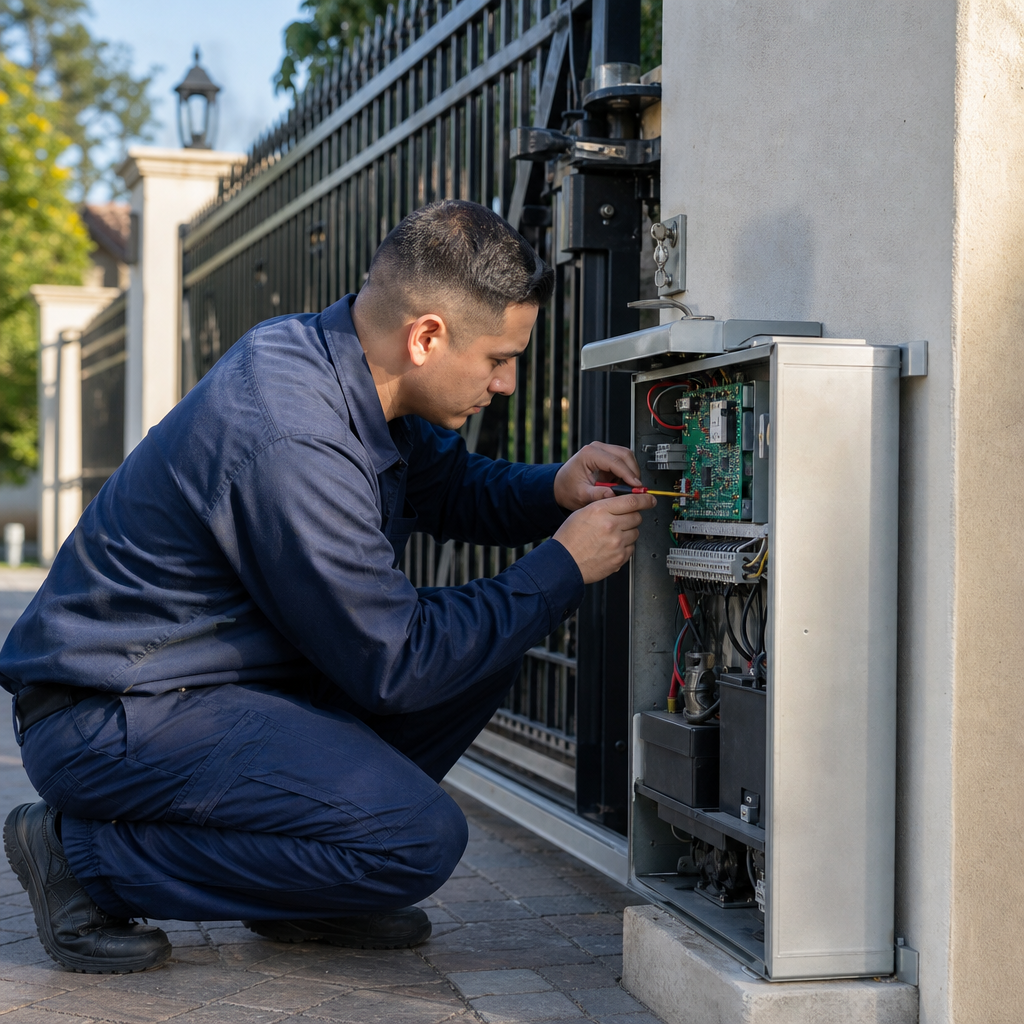
Electrical diagnostics evaluate the core power and control components driving your gate. A motor that hums loudly but fails to move the gate leaf often points to an electrical or capacitor issue rather than a broken drive gear. Verifying terminal voltage, grounding integrity, and circuit board condition prevents costly electrical shorts.
Identifying Electrical Issues and Wiring Fraying
When an operator stops responding, a continuous motor hum or visible component wear can indicate a failing start capacitor or electrical supply issue. Check all internal wiring harnesses for fraying, loose terminal connections, and cracked wire insulation caused by heat and vibration.
Protecting Circuit Boards from Pest and Moisture Damage
Outdoor control boxes are vulnerable to insects, pests, and moisture that can bridge live circuits and corrode sensitive contacts. A thorough electric gate maintenance inspection includes opening the housing, inspecting weather seals, tightening loose terminal blocks, and clearing debris before moisture or pests damage the board.
6. Drive Chain, Belt, and Articulated Arm Calibration
Need automatic gate maintenance checklist?
We’re available now - call for a fast, free estimate.
According to Ironworks Gate Co., calibrating drive chains, belts, and articulated arms ensures mechanical force transfers smoothly from the motor to the gate leaf without stripping gears. Proper physical alignment prevents vibration, balances load distribution, and stops the gate from slamming into hard stops.
Setting Proper Tension and Fastener Tightness
For sliding gates, check drive chain and belt tension across the entire span to avoid excess slack or over-tightening. Excess tension strains motor drive bearings, while slack chains can slip. For swing operators, inspect articulated arms and linear actuators for joint play, loose mounting brackets, and surface rust.
Inspecting Limit Switches and Stop Brackets
Inspect limit strike plates, stop brackets, and fasteners for rust and physical tightness. Ensure limit switches cut motor power cleanly just before the gate reaches its positive physical stops. Correcting travel parameters after any post or ground movement prevents the motor from straining against stationary stops.
7. Access Control, Keypad, and Loop Detector Verification
Access control verification ensures input devices trigger the operator reliably while preventing false openings, lockouts, and gate strikes. Routine testing of keypads, induction loops, and wireless transmitters protects control board relays from intermittent signal faults.
Testing Keypads, Intercoms, and Wireless Remotes
- Clean and inspect keypad buttons: Check digital entry pads and telephone intercoms for sticky keys, corrosion, wiring fraying, and clear audio transmission.
- Check transmitter power: Replace batteries periodically in wireless remotes and keyless pedestals to prevent signal dropouts and shortened range.
Inspecting Exit Loop and Safety Loop Sensitivity
In-ground induction loops require appropriate sensitivity calibration to avoid false triggers while reliably detecting approaching vehicles. Regular testing confirms loop lead-in wiring and detectors function properly during vehicle approach.
8. Emergency Manual Release and Battery Backup Test
Testing your emergency release and battery backup ensures uninterrupted property access during power outages or mechanical faults. Checking manual overrides guarantees you can bypass the motor quickly without tools or risk of injury.[3]
Operating the Manual Key Release
To safely disengage the gate during a power failure:
- Insert the key into the operator lock or locate the mechanical quick-release mechanism.
- Operate the release mechanism to decouple the internal drive from the gate leaf.
- Move the gate leaf manually to confirm it moves freely across its travel path without binding and that hardware remains properly aligned.
Keep manual release keys stored in an accessible, secure location on-site so property managers or residents can operate the entrance during power interruptions.
Testing Battery Backup During Power Outages
Backup batteries lose storage capacity over time. Test your system periodically by disconnecting the primary AC power supply and running open-and-close cycles on backup power alone. If the gate hesitates, slows significantly, or fails to operate, service or replace the battery unit.
Frequently Asked Questions About Automatic Gate Maintenance
How often should an automatic driveway gate be inspected and serviced?
Property owners can perform routine visual checks, such as clearing tracks and testing safety photo-eyes. Depending on local municipal requirements, such as in the City of San Mateo, formal professional safety inspections are mandated at least once every five years.[1]
What are the primary warning signs that a gate opener is failing?
Common warning signs include a motor that hums without moving the gate, squealing hardware, slower travel speeds, intermittent stops midway through a cycle, and visible rust or loose brackets along the track or mounting posts.
When should you hire a professional technician instead of handling repairs yourself?
While clearing track debris and replacing remote batteries are routine tasks, you should contact a professional like Ironworks Gate Co. for shifting posts, structural repairs, electrical control board issues, or inspecting and verifying UL 325 and ASTM F2200 entrapment protection systems.
Need automatic gate maintenance checklist?
We’re available now - call for a fast, free estimate.
Sources
- [PDF] 2015 Annual Report – Consumer Product Safety Commission – cpsc.gov (2015)
- New Safety Standard for Automatic Security Gates Helps … – cpsc.gov (2000)
- Final Rule – Safety Standard for Gates and Enclosures – CPSC – cpsc.gov
- General Requirements for Automatic Gates – sananselmo.gov
Related reading: Gate Sensor Repair – Call Now-10% Off – On-Site in 60 Minutes – Free Estimate
Frequently Asked Questions
What type of lubricant should never be used on automatic gate tracks and hinges?
Avoid standard WD-40 or heavy automotive motor oils on tracks and open pivot points, as they attract abrasive dirt and wash off in rain. Instead, apply a marine-grade water-resistant grease or dry silicone spray to protect bearings and hinges without accumulating gritty debris.
How can you tell if a gate motor failure is caused by physical drag rather than an electrical fault?
Disengage the drive motor using the manual release key and slide or swing the gate leaf across its full path by hand. If the gate moves effortlessly without sticking points, the humming motor likely stems from a failing start capacitor or control board issue requiring diagnostic service from Ironworks Gate Co.
How often should an automatic gate backup battery be tested and replaced?
You should test the backup battery every six months by cutting main AC power and running a full cycle to confirm smooth travel. Most 12V or 24V gate operator batteries lose holding capacity after two to three years and require replacement to prevent entrapment during power outages.
About the author
 |
Marcus Thorne Marcus Thorne is a security infrastructure specialist with over a decade of experience in automated gate systems and perimeter defense. Holding a degree in Mechanical Engineering from California State Polytechnic University, Pomona, he previously worked as a technical consultant for commercial property management firms across Southern California. Marcus focuses on providing clear, actionable advice on gate repair, maintenance costs, and security upgrades for residential and commercial properties. |
Gate not opening, off track, or opener dead?
We’re available now - call for a fast, free estimate.
Call Now - Free Estimate