
Quick Summary
Power outages and hardware errors can trap vehicles behind automated driveway barriers, making it essential to know how to manually open electric gate systems without stripping internal gears or causing personal injury. Property owners can safely disengage their operators by cutting the power supply and turning the mechanical release key, though Ironworks Gate Co. recommends requesting same-day professional service if mechanisms bind or tracks derail. After reading this guide, you will be equipped to safely disengage sliding or swing gates, secure the open leaf, and determine when emergency technical repairs are required.
Manually Open Electric Gate Fast: Safe Emergency Guide
When power fails, a storm knocks out a transformer, or an operator board errors out, an automated driveway gate can trap your car in the driveway. Most automated systems include an emergency manual override. Knowing how to manually open electric gate hardware safely protects your drive gears, prevents burned-out motor components, and keeps you from getting hurt by heavy, shifting ironwork.
Emergency Driveway Gate Manual Override: Quick Guide & TL;DR
Quick Override Sequence: Cut power at the breaker box to prevent sudden restarts. Locate your operator’s manual release access door, insert the manufacturer release key (or turn the release lever/cam), and rotate it to disengage the gearbox. Once disconnected, push the gate open smoothly by hand and secure it in place so wind or slope does not swing it back into your vehicle.
Immediate Action Steps for Trapped Vehicles
If you need to get your vehicle out immediately, take these exact steps in order:
- Kill the Power Supply: Switch off the dedicated electrical breaker or flip the power switch inside the motor chassis. This prevents electrical backfeed and stops the motor from suddenly kicking on while your hands are on the drive linkage.
- Unlock and Turn the Release Mechanism: Insert your mechanical override key into the cylinder on the side or top of the motor housing. Turn the key clockwise (or pull the release lever 90 degrees, depending on the operator) to separate the drive gears from the gate.
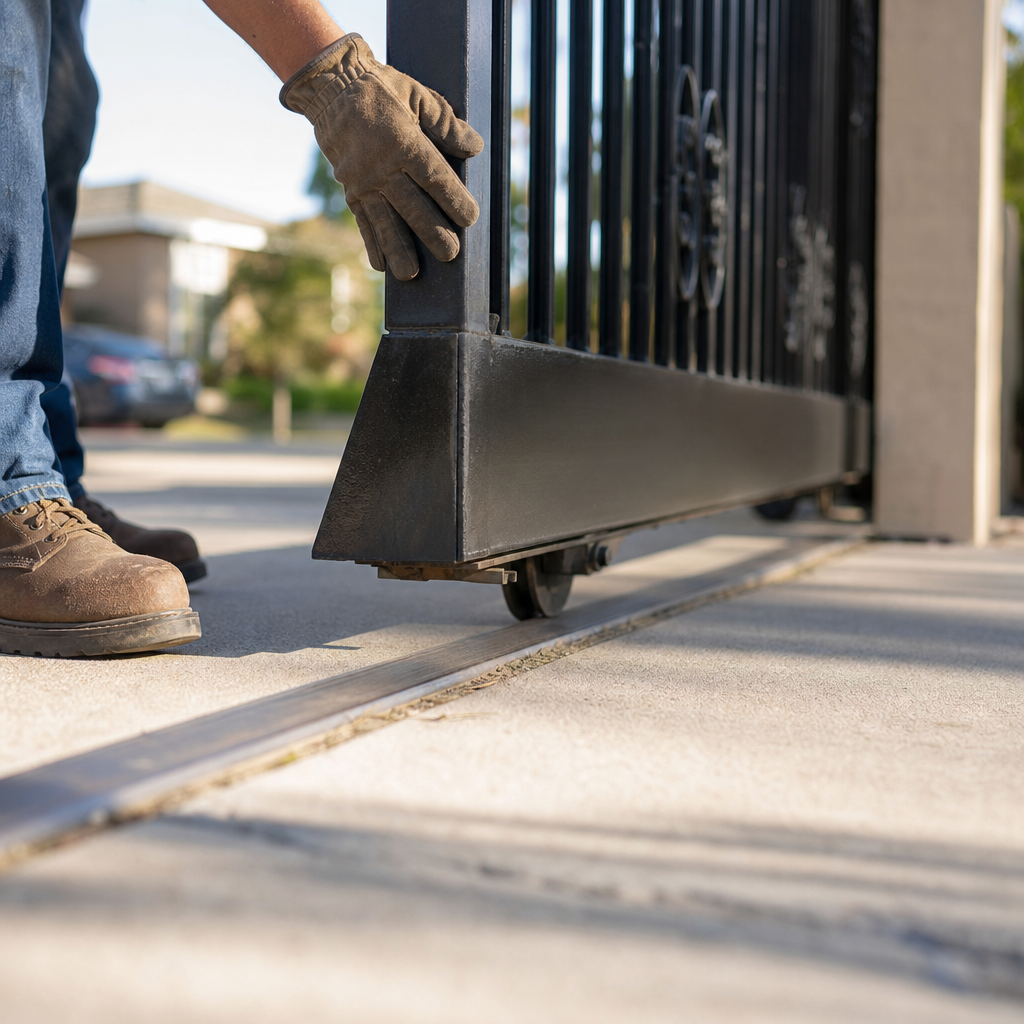
- Manually Slide or Swing the Gate Open: Grip the structural frame of the gate (never put your fingers between pickets, hinge gaps, or track rollers) and push it open slowly.
- Secure the Gate Leaf: Secure the gate in the open position to keep it from moving while you drive through.
When to Stop and Call for Professional Diagnostic Dispatch
Never force a stuck release mechanism with cheater pipes, vice grips, or hammers. Stop immediately and call a licensed gate technician if you encounter any of the following conditions:
- The release key binds, bends, or refuses to turn.
- The gate track has jumped its ground rail, or overhead guide rollers have collapsed.
- A hinge or mounting post has cracked, shifted, or separated from its brick pilaster.
- The gate is physically pinched due to ground settling or driveway frost heave.
- The chain on a sliding gate has snapped, bunched, or derailed into the sprocket housing.
What You’ll Need Before Disengaging an Automatic Gate Opener
Handling heavy gates requires basic safety preparation to prevent pinched fingers or strained backs, especially on older iron systems.[2]
Required Tools and Safety Gear
- Manufacturer Release Key: The specific cam key, triangular key, or Allen key provided with your operator.
- Work Gloves: Heavy leather gloves to protect your hands from pinch points, sharp iron pickets, and weathered chain links.
- Flashlight or Headlamp: Clear illumination for finding lock cylinders, limit cams, and clutch pins in dark or rainy conditions.
- Gate Securing Device: A suitable device or method to secure the gate in the open position.
Locating Your Operator Release Key and Access Panel
Release mechanisms differ depending on whether you have a slide operator, an articulating swing arm, or a linear screw-drive ram:
- Slide Gate Motors: The release key slot is typically on the front or side of the main housing. Turning the key releases an internal clutch or drops the drive sprocket tension. Some slide gates use a red pull-handle or chain disconnect pin.
- Linear Actuator Swing Arms: Look on the top or rear collar of the arm. Slide back the rubber dust cover to reveal a key cylinder or twist-release handle.
- Underground Operators: Usually feature a special splined lever or socket inserted directly into the shoe box under the bottom gate hinge.
Manual Release Procedures and Safety Guidance
Need manually open electric gate?
We’re available now - call for a fast, free estimate.
Each gate style handles mechanical disengagement differently. Applying the correct method keeps you safe and prevents internal gear teeth from stripping.
Operating the Release Mechanism
Follow the specific procedure matching your gate type:
- For Sliding Gates: Unlock the key cylinder on the motor case and pull the disengagement lever outward until it clicks. If your motor uses a manual chain disconnect, pull the cotter pin or release latch on the chain bracket attached to the bottom frame of the gate. This disconnects the gate from the drive chain completely.
- For Swing Gate Arms: Unlock the key access door on top of the ram, then pull the cam handle upward or turn the hex-key mechanism 180 degrees. This releases the internal screw-drive or hydraulic pressure, allowing the telescoping shaft to move freely.
- For Overhead or Articulating Arms: Locate the release pin connecting the articulating arm to the gate bracket. Pull the spring-loaded ring or remove the linchpin to disconnect the arm from the gate leaf.
Moving and Securing the Gate
Once the motor is disconnected, slowly push the gate open by applying force directly to the end post or main structural upright. Pay attention to how the gate feels. It should roll or swing smoothly with steady manual pressure. According to the installation team at Ironworks Gate Co., if you feel scraping, grinding, or severe resistance, inspect the track for rocks or check if the hinges lack grease. Always secure the gate open before moving your vehicle through the opening.
Re-Engaging the Operator
To return the gate to normal automatic operation, follow the manufacturer’s instructions for re-engaging the operator.
Troubleshooting Jammed Manual Releases
When a manual release refuses to turn, mechanical binding may be a factor. As an unverified practical tip, having a second person gently push the gate leaf away from its resting point while turning the release key may help relieve tension on the mechanism if it is caught against a stop or latch.
Frequently Asked Questions About Manual Gate Operation
Manual Operation and Service Answers
How do I manually open an electric gate during a power outage?
Turn off the power switch or main breaker to prevent unexpected movement. Locate the manual release access on your motor (key cylinder, pull-lever, or chain quick-release), disengage the mechanism using your key, and push the gate open by hand along its normal path of travel.
Where is the manual release key or lever located on an automatic gate?
On slide gate operators, it is located behind a small, key-locked access door on the outer chassis. On linear swing gate arms, it sits on the top or rear of the actuator arm under a protective weather cap.[1]
How do you disengage a sliding electric gate opener?
Unlock the release hatch on the motor housing and pull the clutch handle out, or pull the quick-release pin on the chain bracket where the chain links attach to the gate frame.
What should I do if I lost the manual override key for my gate?
Do not attempt to pry the operator housing open with a crowbar. Check your operator brand and model number; replacement keys can often be ordered by key code. If you are locked out during an emergency, a certified technician from Ironworks Gate Co. can unlock the chassis or safely remove the drive arm bolts from the gate mounting bracket.
Can you force push an electric gate open without damaging the motor?
No. Pushing against a fully engaged gate motor forces the internal worm gears, hydraulic valves, or planetary gear sets against each other. This will strip gear teeth, bend drive arms, or crack the operator casing. Always disengage the manual release before attempting to move the gate.
How do I re-engage the automatic gate motor after manual release?
Return the gate to normal automatic operation according to the manufacturer’s instructions.
Need manually open electric gate?
We’re available now - call for a fast, free estimate.
Sources
- guidance for commercial premises – gate-safe.org
- AUTOMATIC GATES – gate-safe.org
Related reading: Automatic Gate Maintenance Checklist – Call Now-10% Off – Same-Day Service – Free Estimate
Related reading: Gate Sensor Repair – Call Now-10% Off – On-Site in 60 Minutes – Free Estimate
Frequently Asked Questions
How do I properly re-engage an electric gate opener after manual operation?
To re-engage the system, position the gate near its closed state, reverse the release key or lever until the internal clutch clicks back into place, and restore power at the breaker. Run a complete test cycle with your remote control to ensure the motor recalibrates its open and close limit positions correctly.
What should I do if the manual release key refuses to turn or gets stuck?
Do not force the key with pliers or cheater bars, as this can shear the lock cylinder or crack the gearbox housing. If gently taking physical pressure off the gate leaf fails to free the mechanism, call Ironworks Gate Co. for emergency same-day dispatch to safely disconnect the drive assembly.
Will manually opening an electric gate disrupt its programmed limit switch settings?
Manually moving a properly disengaged gate will not damage the internal limit switches or erase the motherboard's programming. Once the drive clutch is locked back in and power returns, the operator will automatically read its physical stops during the next full cycle.
About the author
 |
Marcus Thorne Marcus Thorne is a security infrastructure specialist with over a decade of experience in automated gate systems and perimeter defense. Holding a degree in Mechanical Engineering from California State Polytechnic University, Pomona, he previously worked as a technical consultant for commercial property management firms across Southern California. Marcus focuses on providing clear, actionable advice on gate repair, maintenance costs, and security upgrades for residential and commercial properties. |
Gate not opening, off track, or opener dead?
We’re available now - call for a fast, free estimate.
Call Now - Free Estimate