
Quick Summary
Routine electric gate maintenance is essential to prevent structural drag, mechanical binding, and component wear from escalating into expensive motor failures and safety hazards. Ironworks Gate Co. delivers comprehensive preventative care by combining structural alignment diagnostics with precision motor electronics to service track rollers, hinge pivots, safety sensors, and control boards. Readers will understand key signs of gate failure, distinguish between basic owner upkeep and professional diagnostics, and learn how to schedule a preventative maintenance service to ensure safe, reliable operation.
Electric Gate Maintenance: Fast Care to Prevent Failures
Powered gates are heavy, motorized machinery assemblies that experience continuous mechanical strain, environmental exposure, and electrical wear. The Health and Safety Executive (HSE) states that powered gates should be maintained like other machinery and that safety features and closing forces should be tested regularly.[1]
When an automated driveway gate begins to stick, hum, or stop halfway across the driveway, property owners often assume the motor or control board has failed. In practice, electrical faults are frequently the end result of unaddressed physical drag. Professional electric gate maintenance examines both the structural foundation and the electronic access components to keep the system moving safely and reliably. See also Automatic Gate Troubleshooting – 10% Off & Free Estimate – Same-Day Service.
What Professional Electric Gate Maintenance Includes
Maintenance overview: A complete electric gate service includes inspecting the structural foundation and hinge alignment, checking motor components, clearing and leveling ground tracks, checking safety photo-eyes and contact edges, measuring closing forces, and lubricating moving parts. Service frequency depends on the gate’s design, use, environment, and safety risks; a competent professional should determine the schedule.
General technical guidance: An effective maintenance routine balances physical structural alignment with electrical diagnostics. Over time, shifting in mounting structures can create mechanical drag, increasing strain on the motor and associated operating components.
Key Benefits of Scheduled Service
Preventative upkeep identifies worn hardware and safety blind spots before they lead to entrapment risks or blocked driveways.
- Reduced Drive Motor Strain: Routine leveling, roller replacement, and hinge lubrication minimize friction, helping opener motors operate smoothly.
- Documented Safety and Force Compliance: Measuring equipment can be used to test closing forces, and safety features should be tested and recorded.
- Foundation and Substrate Protection: Catching post deflection or masonry cracking early prevents expensive rebuilding of structural pilasters and mounting plates.
Signs Your Gate Opener Needs Immediate Service
If your gate requires repeated control board resets, stutters during opening cycles, or screeches during travel, the mechanical assembly is binding. Grinding sounds inside the gearbox, motors that hum without moving the gate leaves, and safety photo-eyes that fail to trigger are clear warnings that the system requires technical evaluation. Do not operate gates that are unsafe or defective.[3]
DIY Gate Upkeep vs. Professional Electric Gate Service
Property owners must follow manufacturer instructions, isolate power before maintenance, and avoid operating unsafe or defective gates. Always use competent personnel for electrical, safety-control, adjustment, and hazardous moving-part work.[5]
| Maintenance Scope | DIY Property Owner | Qualified Service Technician |
|---|---|---|
| Track Debris & Visual Check | ✓ Clears surface debris and washes photo-eye lenses (with power isolated) | ✓ Inspects track anchors, depth, and subgrade settling |
| Force & Safety Feature Testing | ✗ Refer to competent personnel | ✓ Measuring equipment closing force testing and safety edge diagnostics |
| Structural & Alignment Diagnostics | ✗ Basic visual check for obvious sagging | ✓ Post plumb measurements, hinge load balancing, foundation checks |
| Maintenance Documentation | ✗ Informal notes | ✓ Formal testing records and maintenance log compliance |
Safety audits conducted by industry organizations like Gate Safe have found that a large majority of existing automated gates exhibit safety deficiencies, with missing safety edges, inadequate entrapment protection, and inadequate hinge protection and other installation defects being among the most common defects. Furthermore, the Irish Health and Safety Authority (HSA) emphasizes that powered gates must be kept in safe operating condition through planned preventative maintenance, with all force tests and safety device checks formally recorded in a maintenance log.[2]
1. Inspecting Structural Pilasters and Masonry Foundation Alignment
General technical guidance: Structural movement in mounting pilasters can affect gate operation. Over time, physical movement can cause mounting structures to shift out of plumb.
When a pilaster shifts, the gate leaf can drop out of square, introducing resistance across its travel arc. As practiced by Ironworks Gate Co., technicians check the plumb of support posts and inspect mounting brackets and anchors to correct physical alignment before electronic adjustments are made.
2. Clearing, Leveling, and Securing Sliding Gate Tracks and Rollers
Need electric gate maintenance?
We’re available now - call for a fast, free estimate.
General technical guidance: Ground-mounted sliding gates depend on a level, stable steel track. Dirt, stones, and road grime accumulate along the track groove, obstructing travel. Over time, driveway concrete may settle, causing track alignment issues.
Technicians inspect the fasteners securing the track, repair loose anchors, and verify track straightness. They also inspect bottom roller wheels and bearings, replacing damaged components to ensure smooth movement.
3. Lubricating Heavy Hinges and Pivot Points
General technical guidance: Automated swing gates place continuous stress on hinge pins. When lubricants degrade, friction increases the load on linear actuators and articulated arms.
Always follow the manufacturer’s instructions for approved lubricant types and application methods. Technicians service hinge fittings, inspect bearings for wear, and examine weld joints connecting hinge barrels to the gate frame.
4. Testing Motor Components, Control Boards, and Limit Switches
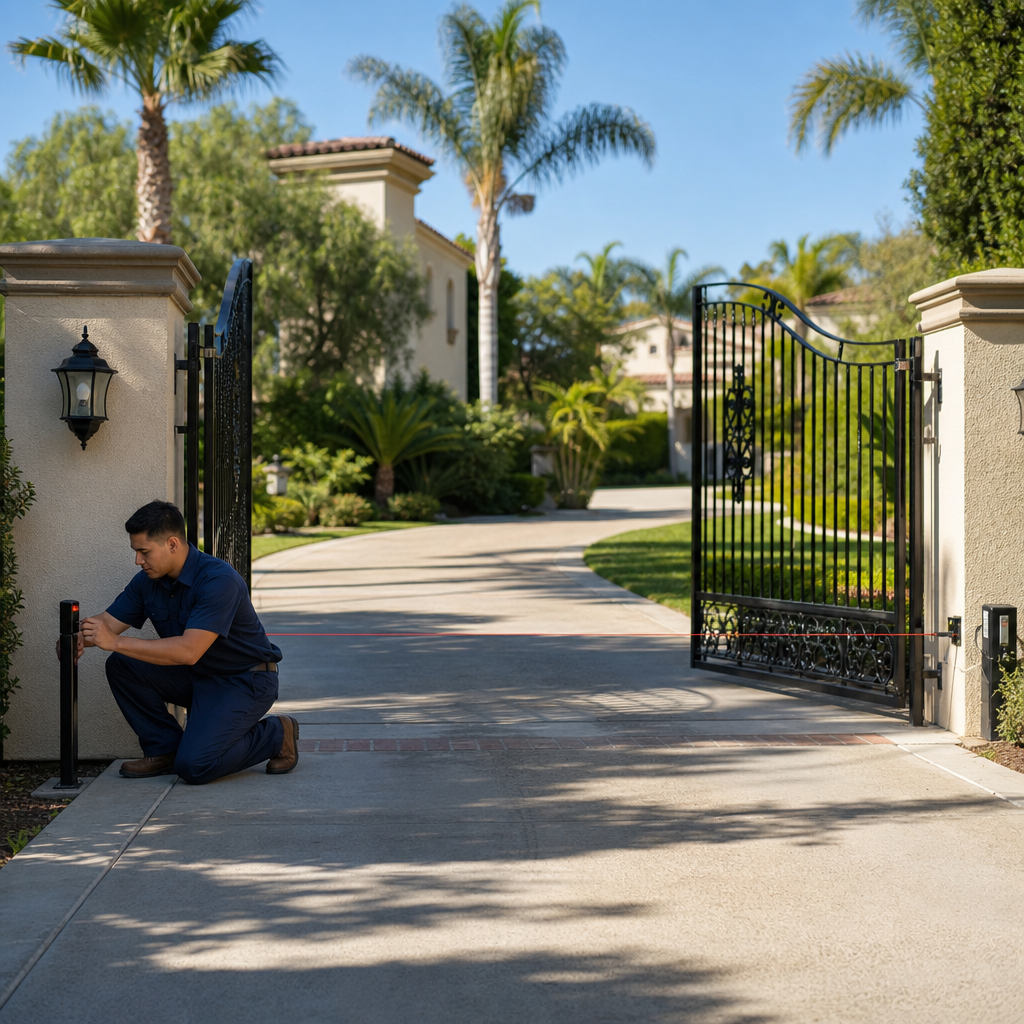
General technical guidance: Electric gate operators rely on electrical and electronic control assemblies that require periodic checks. Operating cycles and weather exposure can affect control boards, wiring terminals, and limit switch settings.
Competent personnel, such as those from Ironworks Gate Co., inspect control enclosures, verify terminal connections, and test limit switches so the gate decelerates and stops safely at its intended positions.
5. Calibrating Photo-Eye Safety Sensors and Entrapment Protection
Safety photo-eyes prevent gates from closing on vehicles, pedestrians, or pets. Misaligned mounting brackets, cracked lenses, or dirty optics can cause operational faults.
Technicians clean optical lenses, check wiring, and align sensor beams. Measuring equipment can be used to test closing forces, and safety features should be tested and recorded to ensure obstacle-reversal systems function properly.
6. Tensioning Drive Chains and Inspecting Gearbox Belts
Need electric gate maintenance?
We’re available now - call for a fast, free estimate.
General technical guidance: Sliding gates driven by roller chains require proper chain tension. An improperly adjusted chain or worn drive component can cause erratic movement or excess wear on drive assemblies.
Technicians inspect drive chain tension according to manufacturer specifications, check sprocket alignment, and inspect drive belts for signs of wear or cracking.
7. Inspecting Keypads, Telephone Entry Systems, and Low-Voltage Wiring
General technical guidance: Access control accessories like keypads, wireless receivers, and telephone entry systems are exposed to rain, dust, and direct sun. Moisture ingress can cause corrosion on low-voltage connection points and lead to communication faults.
Technicians, including teams from Ironworks Gate Co., inspect enclosure seals, check wiring terminals, test operating voltages, and check the condition of backup batteries according to manufacturer recommendations.
8. Verifying the Emergency Manual Release Mechanism
Every automated gate must have a working manual release so it can be operated by hand during an electrical outage or equipment failure. Direct users to the manufacturer’s instructions for the correct manual release procedure for their specific model.
During a routine service visit, the technician tests and services the manual disconnect mechanism according to manufacturer procedures to ensure safe, smooth operation.
How Much Does Professional Electric Gate Maintenance Cost?
Cost overview: Maintenance costs vary by location, gate type, condition, usage, and required work, so a written quote is needed from a qualified service provider.
Standard preventative maintenance helps avoid emergency service calls caused by long-term mechanical binding and undetected component wear.
Primary Cost Factors
- Gate Type and Layout: Large commercial slide gates or dual swing systems require more inspection time and safety force measurements than standard single-swing residential gates.
- Substrate and Structural Repairs: Realigning shifting posts, repairing hinge mountings, or securing sunken ground tracks adds labor and material costs.
- Replacement Hardware: Routine wear parts such as drive belts or rollers have different replacement costs than control circuit boards or drive units.
Frequently Asked Questions About Electric Gate Maintenance
How often does an electric gate need servicing?
Service frequency depends on the gate’s design, use, environment, and safety risks; a competent professional should determine the schedule.
What is included in an electric gate maintenance checklist?
A professional checklist, such as the standard used by Ironworks Gate Co., includes structural post and hinge alignment, track and roller clearing, checking motor components, limit switch adjustment, photo-eye and safety edge testing, force limitation measurement, drive chain or belt inspection, access control wiring checks, and manual release verification.
Can I lubricate and maintain an automated driveway gate myself?
Property owners can perform basic visual checks and clear surface debris, provided they follow manufacturer instructions and isolate power before maintenance. Owners must avoid operating unsafe or defective gates. Competent personnel must be used for electrical, safety-control, adjustment, and hazardous moving-part work.
What type of lubricant is best for electric gate hinges and tracks?
Consult the gate manufacturer’s instructions for recommended lubricant specifications and application guidelines suited to your specific hardware.
What are the signs that an electric gate opener needs repair or servicing?
Key warning signs include a motor that hums without moving the gate, grinding noises during travel, intermittent stops before reaching open or closed limits, dragging along the driveway surface, screeching hinges, and access keypads that only work intermittently. Do not operate gates that are defective or unsafe.[4]
How do I manually open an automatic gate during a power outage?
Refer to the manufacturer’s instructions for the specific manual-release procedure for your gate operator. Use the manufacturer-specified release key or handle to disengage the drive mechanism, and keep manual release tools accessible for emergencies.
Need electric gate maintenance?
We’re available now - call for a fast, free estimate.
Sources
- Ensuring powered doors and gates are safe – hse.gov.uk
- Help and Advice for Industry Professionals involved … – gate-safe.org (2008)
- Gate Accidents – The needless loss of life continues – gate-safe.org (2022)
- Major accidents involving automated gates and lessons … – gate-safe.org (2016)
- Over 90% of commercial gates deemed unsafe – gate-safe.org
Related reading: Automatic Gate Opener Troubleshooting – Call Now-10% Off – Same-Day Service – Free Estimate
Related reading: Manually Open Electric Gate – Call Now-10% Off – Same-Day Service – Free Estimate
Related reading: Automatic Gate Maintenance Checklist – Call Now-10% Off – Same-Day Service – Free Estimate
Frequently Asked Questions
Why does structural gate sagging cause electric opener motor failure?
When mounting pilasters shift or hinge pivots wear down, physical gate sagging creates severe mechanical drag across the opening arc. This friction forces the operator to draw excessive electrical current, ultimately burning out drive motors and control boards. Ironworks Gate Co. applies dual-trade structural alignment and electrical diagnostics to resolve foundational binding before motor components suffer permanent damage.
How often should high-traffic or weather-exposed electric gates be professionally serviced?
While low-cycle residential gates typically require annual maintenance, high-traffic commercial systems and gates exposed to regional weather extremes should be serviced every three to six months. Frequent inspections prevent dirt build-up in ground tracks, corrosion on low-voltage terminals, and premature drive chain slack. Ironworks Gate Co. offers customized preventative service schedules and same-day assessments to maintain peak reliability in harsh conditions.
What safety compliance tests are required during an electric gate maintenance inspection?
A certified maintenance visit requires dynamic closing force measurements, obstruction-reversal calibration, and functional testing of photo-eyes and contact edges. Technicians must also verify that emergency manual release mechanisms operate freely during power cuts. Ironworks Gate Co. documents all force tests and safety device checks in a formal maintenance log to ensure ongoing regulatory compliance and eliminate entrapment hazards.
About the author
 |
Marcus Thorne Marcus Thorne is a security infrastructure specialist with over a decade of experience in automated gate systems and perimeter defense. Holding a degree in Mechanical Engineering from California State Polytechnic University, Pomona, he previously worked as a technical consultant for commercial property management firms across Southern California. Marcus focuses on providing clear, actionable advice on gate repair, maintenance costs, and security upgrades for residential and commercial properties. |
Gate not opening, off track, or opener dead?
We’re available now - call for a fast, free estimate.
Call Now - Free Estimate